
Solid Timber vs Engineered Wood Flooring

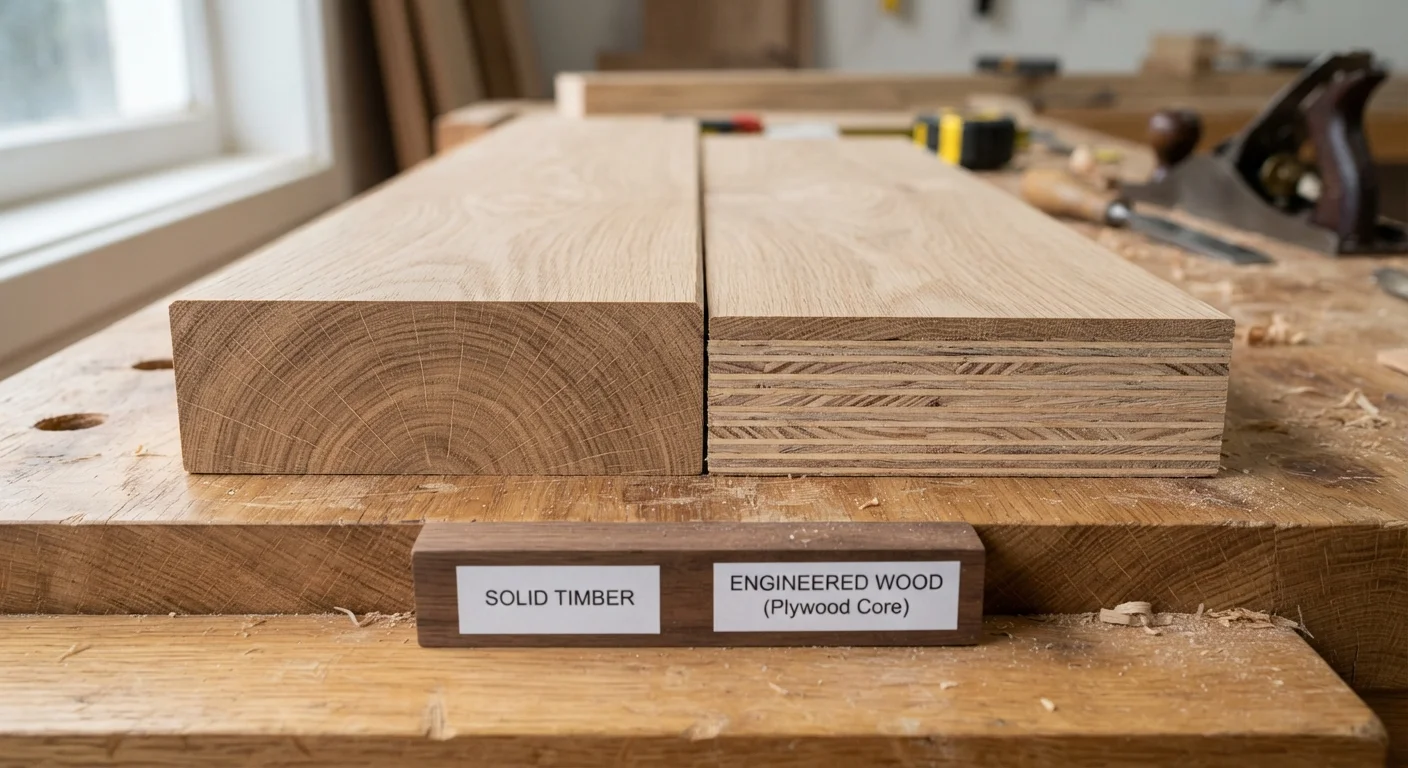
Photo: ResultsExplorer.com | Top Blogs For Everyone editorial
Key Takeaways
- Solid timber can be sanded and refinished multiple times over decades; engineered wood offers fewer refinishing cycles.
- Engineered wood resists moisture-driven expansion and contraction significantly better than solid timber.
- Both products can look virtually identical on the surface - the difference lies in their core construction.
- Engineered wood is generally compatible with underfloor heating; solid timber rarely is.
- Solid timber typically commands a higher upfront cost but may deliver longer lifespan in the right conditions.
- Local humidity, subfloor type, and room use should drive your flooring choice more than aesthetics alone.
What's Actually Inside Each Plank
Despite looking nearly identical from above, solid timber and engineered wood are fundamentally different products. Solid timber is exactly what the name implies - a single, uniform plank of wood milled from top to bottom. Its thickness (typically ¾ inch) is the same species throughout, which is what makes repeated sanding possible.
Engineered wood, by contrast, is a manufactured product with a thin hardwood veneer - usually 2-6mm thick - bonded over multiple layers of cross-ply plywood or high-density fiberboard (HDF). These cross-directional layers are what give engineered boards their dimensional stability: when humidity changes, the layers counteract each other's tendency to expand or contract.
This structural difference explains nearly every practical distinction between the two - from where you can install them to how long they'll last.
| Criterion | Solid Timber | Engineered Wood |
|---|---|---|
| Construction | Single species, full depth | Hardwood veneer over plywood core |
| Moisture resistance | Low - avoid damp areas | High - stable in humid rooms |
| Underfloor heating compatible | Generally not recommended | Usually yes - check product specs |
| Below-grade installation | Not recommended | Suitable in most cases |
| Refinishing potential | 4-8 times over its life | 1-3 times, depends on veneer depth |
| Typical lifespan | 50-100 years (stable conditions) | 20-40 years |
| Installation methods | Nail-down over wood subfloor | Float, glue, or nail-down |
Moisture, Movement, and Where Each Floor Belongs
Wood moves with changes in humidity. Every species expands when moisture levels rise and contracts when the air dries out. Managing that movement is the central challenge of any wood floor installation.
Solid timber is highly sensitive to this cycle. In rooms where humidity fluctuates significantly - kitchens, bathrooms, or any below-grade space - solid planks can cup (edges rising), gap, or even split. Most flooring professionals advise against solid timber below grade at all, and recommend careful humidity management above grade using an HVAC system or humidifier.
Engineered wood is substantially more stable. Its plywood core absorbs and releases moisture more evenly, making it suitable for kitchens, open-plan areas with temperature swings, and basement-level installations where solid timber would struggle.
Moisture Testing Before Installation
Underfloor heating is another key differentiator. The gentle, consistent heat from radiant systems causes continuous wood movement. Most engineered wood products are rated for use with underfloor heating; solid timber generally is not, as it dries out and gaps unpredictably.
Lifespan, Refinishing, and Long-Term Value
One of the most common arguments for solid timber is its refinishability. Because the plank is solid through its full depth, it can typically be sanded back and recoated four to eight times over its lifetime - effectively renewing the floor's surface every decade or two as wear, scratches, or style changes demand.
Engineered wood can also be refinished, but the number of times depends entirely on the thickness of the top veneer. A 2mm wear layer may allow one careful sand; a 6mm layer can accommodate two or three. Once that veneer is exhausted, the floor cannot be refinished and must be replaced.
In stable, dry conditions, a quality solid timber floor can last 50 to 100 years. A well-made engineered floor typically delivers 20 to 40 years of service depending on wear-layer thickness and maintenance. Neither outcome is guaranteed - proper installation, humidity control, and maintenance are equally important variables.
¾ inch
Standard solid timber plank thickness
This full-depth construction is what enables multiple sanding cycles across a floor's lifespan.
2-6mm
Typical engineered wood wear layer range
A thicker veneer layer directly determines how many times an engineered floor can be refinished before replacement.
3-5x
Greater moisture stability of engineered vs solid
Cross-ply plywood cores reduce dimensional movement across humidity cycles compared to solid timber planks.
Upfront costs for solid timber tend to be higher, though engineered wood in premium hardwood species can approach similar price points. Installation costs vary by method: engineered boards are often floated or glued, while solid timber typically requires nail-down installation over a wooden subfloor.
The content provided on our blog site traverses numerous categories, offering readers valuable and practical information. Readers can use the editorial team’s research and data to gain more insights into their topics of interest. However, they are requested not to treat the articles as conclusive. The website team cannot be held responsible for differences in data or inaccuracies found across other platforms. Please also note that the site might also miss out on various schemes and offers available that the readers may find more beneficial than the ones we cover.