
Cornell Notes, Mind Maps, and Outlines: Comparing Three Popular Note-Taking Systems

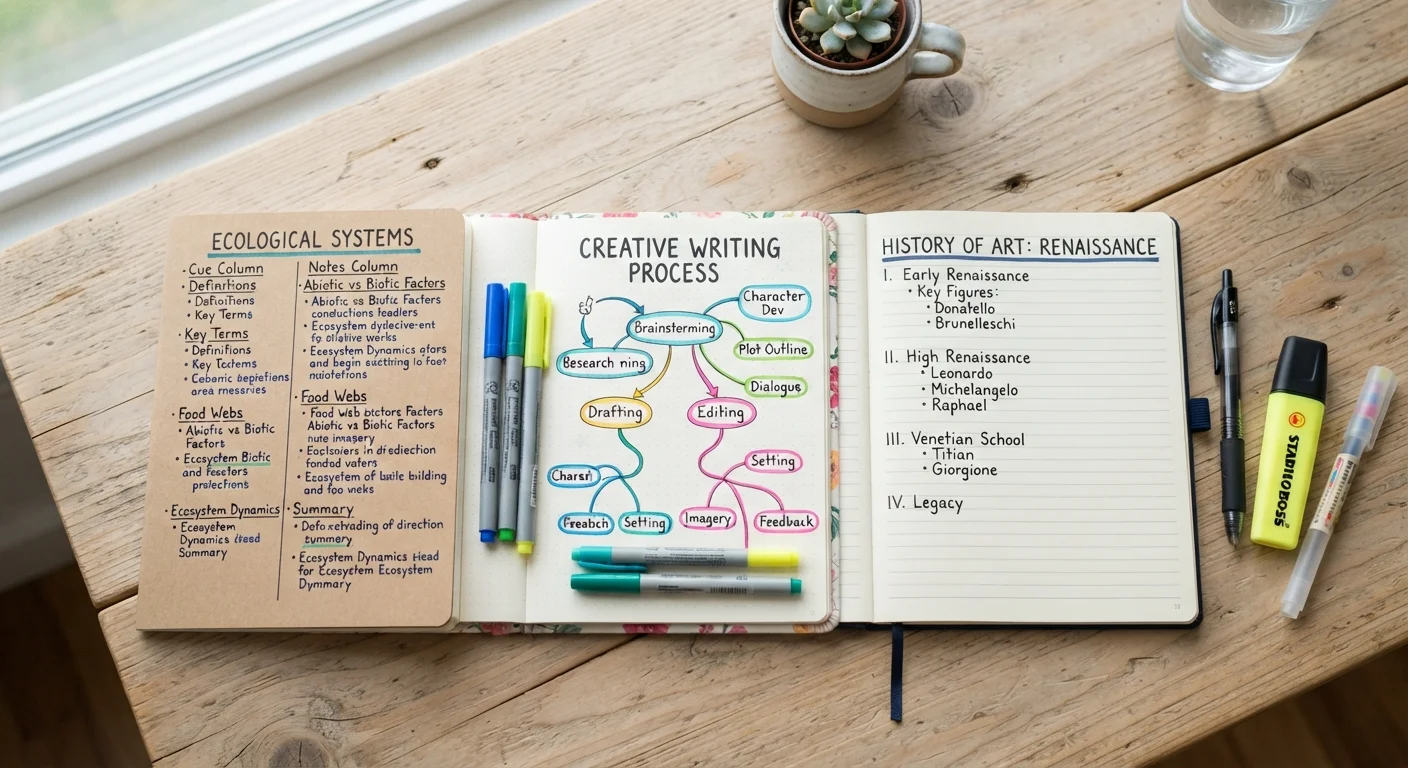
Photo: ResultsExplorer.com | Top Blogs For Everyone editorial
Key Takeaways
- Cornell notes build active recall by separating cues from main content during review.
- Mind maps are especially effective for visual learners and subjects with interconnected concepts.
- Outlines work best for linear, hierarchical content like procedures or structured lectures.
- No single system is universally superior — matching the format to the subject matters most.
- Combining methods across subjects can strengthen long-term retention.
Why Your Note Format Is a Learning Decision
Taking notes isn't just recording information — it's a form of active processing. Research in cognitive science consistently shows that how you organize information as you capture it shapes how well you'll retain and retrieve it later. Yet most people stick to whatever format they learned in school without evaluating whether it actually fits their learning goals.
The three most widely used systems — Cornell notes, mind maps, and outlines — each reflect different assumptions about how knowledge is structured and retrieved. Understanding those differences helps you choose deliberately rather than by default. If you're already thinking about how note-taking fits into a broader study strategy, this guide on common note-taking errors is worth reading alongside this comparison.
Cornell Notes: Built for Review
Developed at Cornell University in the 1950s, the Cornell method divides each page into three zones: a narrow left column for cue questions, a wide right column for main notes, and a summary section at the bottom. The design isn't arbitrary — it mirrors the retrieval practice principle, one of the most robustly supported techniques in learning science.
During a lecture or reading session, you take notes in the right column. Afterward, you write questions or keywords in the left column that prompt you to recall the content. Covering the right column and answering from the cues is a built-in self-testing routine. For a deeper look at why retrieval practice works, see our field guide to evidence-based learning techniques.
Best subjects: History, science, law, any lecture-based course with distinct facts and concepts.
Main limitation: Less intuitive for subjects where ideas don't break into clean question-answer pairs.
Write Cue Questions Immediately After Class
Mind Maps: Thinking in Connections
A mind map starts with a central idea and branches outward, with related concepts linked by lines or curves. The format is non-linear by design, which makes it well suited to subjects where relationships between ideas matter as much as the ideas themselves — think biology, project planning, or brainstorming an essay argument.
Mind maps engage spatial reasoning and encourage you to surface connections you might miss in a list format. They can be drawn by hand or built digitally. The main trade-off is that they can become visually cluttered when a topic is highly detailed, and they require more active curation than simply writing sequential notes.
Best subjects: Biology, literature analysis, social sciences, creative planning, any subject with overlapping themes.
Main limitation: Can be time-consuming to create neatly; harder to use for dense, fact-heavy material.
| Cornell Notes | Mind Maps | Outlines | |
|---|---|---|---|
| Best for | Lecture-based, fact-rich content | Conceptual, creative, or linked topics | Structured, sequential material |
| Built-in review mechanism | Yes — cue column for self-testing | Partial — visual recall of structure | No — requires separate review step |
| Ease of setup | Moderate — requires page division | Low — start anywhere | High — simple numbered lists |
| Works for non-linear content | Somewhat | Very well | Poorly |
| Suitable for digital note-taking | Yes | Yes, with mapping apps | Yes — most natural digitally |
| Learning science alignment | High — supports retrieval practice | Moderate — aids elaboration | Moderate — supports organization |
Outlines: Structure as a Learning Tool
An outline organizes content into a hierarchy: main topics, subtopics, and supporting details arranged with consistent indentation or numbering. It's the oldest of the three formats and remains popular for good reason — it mirrors the logical structure of many textbooks, lab procedures, and formal lectures.
Outlines are particularly effective when the source material is already well-organized, because your notes can essentially shadow that structure. They're less suited to content that's conceptually tangled or exploratory, where forcing a hierarchy can actually hide important relationships.
Best subjects: Chemistry procedures, legal statutes, technical manuals, structured reading assignments.
Main limitation: Imposes a linear hierarchy that may not reflect how complex ideas actually connect.
Whichever system you use, pairing it with a deliberate study schedule improves outcomes. Building a realistic weekly study plan gives you a framework for incorporating regular review of your notes across all three formats.
Choosing — and Combining — Your Systems
Most experienced learners don't choose one system and stick with it across every subject. A practical approach is to match format to function: use Cornell notes for lecture-heavy courses where self-testing is a priority, mind maps when you're trying to synthesize a complex topic before an essay or exam, and outlines when working through structured reading or procedural content.
Combining formats within a single study session is also legitimate. You might outline a chapter's main sections, then draw a mind map to visualize how those sections relate, then create Cornell-style cue questions for the concepts most likely to appear on an exam. This layered approach aligns with what learning research supports — active, varied engagement with material outperforms passive re-reading regardless of the format used.
The most important habit isn't picking the perfect system — it's reviewing your notes regularly and using them to test yourself, not just read them over.
The content provided on our blog site traverses numerous categories, offering readers valuable and practical information. Readers can use the editorial team’s research and data to gain more insights into their topics of interest. However, they are requested not to treat the articles as conclusive. The website team cannot be held responsible for differences in data or inaccuracies found across other platforms. Please also note that the site might also miss out on various schemes and offers available that the readers may find more beneficial than the ones we cover.