
Emergency Vehicle Approaching: Exactly What the Law Requires You to Do

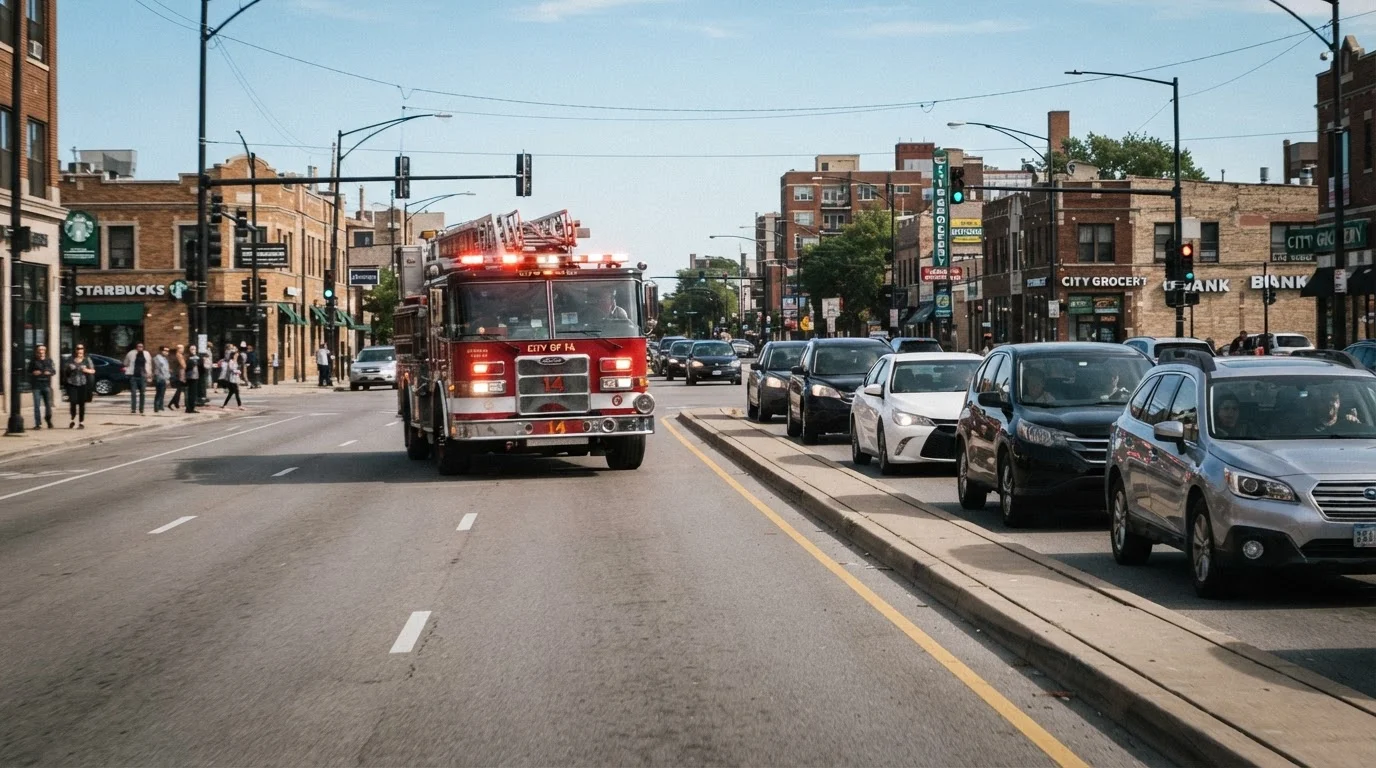
Photo: ResultsExplorer.com | Top Blogs For Everyone editorial
Key Takeaways
- Pull to the right and stop as soon as it is safe when an emergency vehicle approaches with lights or sirens active.
- Remain stopped until the emergency vehicle has fully passed - not just when you first see it clear your bumper.
- Never follow within 500 feet of an emergency vehicle responding to a call; many states set this as the legal minimum.
- Intersections require a full stop, even if you have a green light, when an emergency vehicle is approaching.
- Failing to yield to an emergency vehicle is a moving violation that can result in fines, license points, or both.
What the Law Actually Says
Every US state has a statute requiring drivers to yield the right-of-way to authorized emergency vehicles - typically defined as police cars, fire trucks, and ambulances - when those vehicles are operating with lights and sirens activated. While exact wording varies by state, the core requirements are broadly consistent across the country.
The standard legal obligation has two parts: move to the right edge or curb of the road and stop until the emergency vehicle has passed. Simply slowing down without stopping does not satisfy the law in most jurisdictions. The requirement applies to drivers traveling in both the same direction as the emergency vehicle and, in many states, the opposite direction on undivided roads.
For a deeper look at a related but distinct requirement - what to do when emergency vehicles are stopped on the roadside - see our guide on Move Over Laws: What Every US Driver Needs to Know.
Understanding traffic signals beyond red, yellow, and green also helps drivers interpret the flashing lights and signals emergency vehicles use to clear intersections.
Turn Down the Radio Before You Need To
Step-by-Step: What to Do When an Emergency Vehicle Approaches
The moment you detect flashing lights or a siren, a short sequence of actions is required. Following these steps in order keeps you legal, protects first responders, and prevents secondary crashes.
What you will need
Detect the Emergency Vehicle Early
As soon as you see flashing red, blue, or white lights in your mirrors or hear a siren, begin assessing your surroundings. Check all mirrors to determine the direction and distance of the approaching vehicle. Do not wait until it is directly behind you to start reacting.
Signal Your Intent and Begin Moving Right
Activate your right turn signal immediately to alert following drivers of your intended direction. Begin steering toward the right edge of the road or the nearest curb. On multi-lane roads, check the right lane for other vehicles before changing lanes. Move gradually and deliberately - do not make sharp or sudden maneuvers.
Stop Completely at the Right Edge or Curb
Bring your vehicle to a complete stop as close to the right edge of the road or curb as safely possible. On a highway shoulder, pull fully off the travel lane. On a two-lane road, stop to the right of the center line. Keep your turn signal or hazard lights on so your position is visible to other drivers and to the emergency vehicle crew.
Remain Stopped Until the Vehicle Has Fully Passed
Do not move until the emergency vehicle has passed your position entirely and it is safe to re-enter the travel lane. If multiple emergency vehicles are traveling in convoy, wait for all of them to clear before moving. Look ahead and in your mirrors before pulling back into traffic.
At an Intersection, Stop Before the Crosswalk
If you are at or approaching an intersection when an emergency vehicle activates its lights or siren, stop before the stop line or crosswalk - even if the signal is green. Do not proceed through the intersection until the emergency vehicle has cleared it. This rule applies regardless of what the traffic signal shows.
Never Block an Intersection for Any Reason
Common Mistakes and Legal Consequences
Several driver behaviors - even well-intentioned ones - can result in violations or unsafe conditions.
- Following too closely after passing: Most states prohibit following an emergency vehicle actively responding to a call within 500 feet. Trailing behind to get through traffic faster is a ticketable offense.
- Pulling left instead of right: Unless you are in a one-way street situation where right is not possible, moving left is both incorrect and potentially dangerous, putting you in the emergency vehicle's intended path.
- Re-entering traffic too quickly: You must wait until the vehicle has fully cleared your position - not just when the sound fades slightly.
- Panicking and stopping abruptly in the travel lane: If pulling to the shoulder is not immediately possible, reduce speed steadily, signal, and move as soon as a safe gap in the curb lane appears. Stopping in the middle of a lane creates an obstacle for both the emergency vehicle and other drivers.
Fines for failing to yield to an emergency vehicle vary widely by state, but they are generally treated as moving violations, meaning license points may apply. Repeated violations or incidents resulting in contact with an emergency vehicle can carry significantly higher penalties, including potential reckless driving charges.
It is also worth noting that aggressive or erratic reactions to emergency vehicles - like sudden lane changes that cut off other drivers - can themselves create legal exposure. Our article on road rage behaviors that drivers don't realize are illegal covers how reactive driving can cross into illegal territory.
The content provided on our blog site traverses numerous categories, offering readers valuable and practical information. Readers can use the editorial team’s research and data to gain more insights into their topics of interest. However, they are requested not to treat the articles as conclusive. The website team cannot be held responsible for differences in data or inaccuracies found across other platforms. Please also note that the site might also miss out on various schemes and offers available that the readers may find more beneficial than the ones we cover.