
What the Yellow Lines on US Roads Actually Mean

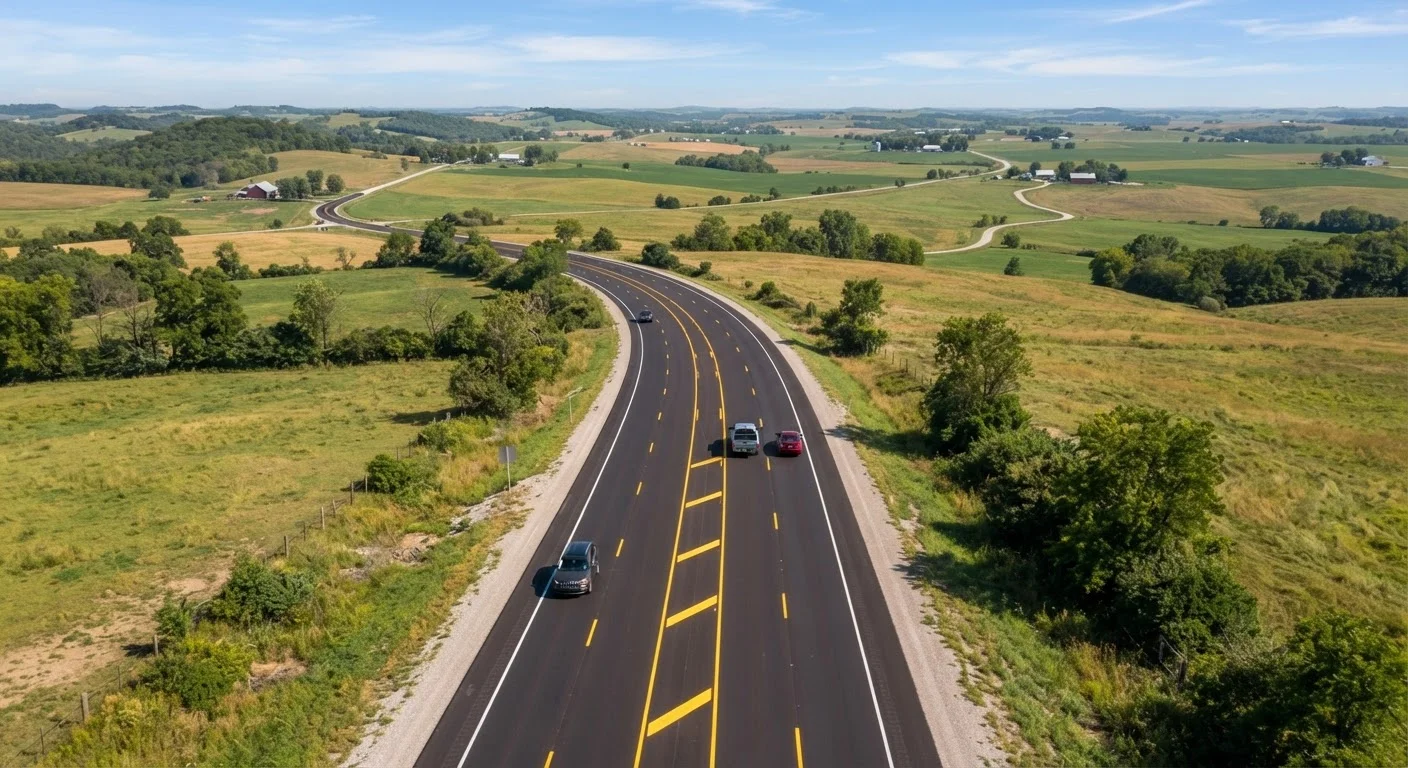
Photo: ResultsExplorer.com | Top Blogs For Everyone editorial
Key Takeaways
- Yellow lines separate opposing traffic flows, while white lines separate same-direction lanes.
- A dashed yellow line on your side means you may pass when it is safe to do so.
- A solid yellow line on your side means passing is prohibited from your direction.
- Double solid yellow lines prohibit passing in both directions.
- A double yellow line may still be crossed to enter or exit a driveway or property in most states.
- Yellow line rules are federally standardized but enforced at the state and local level.
Why Yellow Lines Exist and What They Separate
On US roads, color is the first language of lane markings. Yellow always means center - these lines divide traffic traveling in opposite directions. White lines, by contrast, organize vehicles moving in the same direction. Understanding this fundamental distinction is the foundation for reading any road correctly.
Yellow centerline markings appear on two-lane roads, multi-lane undivided highways, and some urban streets. They tell you at a glance where oncoming traffic begins and help define the physical boundary you must not cross carelessly. The pattern of those lines - dashed, solid, or a combination - layers on a second layer of meaning: whether passing is allowed.
Just as traffic signals carry distinct legal meanings beyond their basic colors, road markings are a formal communication system with federally standardized rules.
The Three Core Yellow Line Patterns
Single Dashed Yellow Line
A single dashed yellow line runs down the center of many two-lane rural roads. It signals that passing is permitted from either direction, provided you can do so safely - meaning you have clear sight distance, no oncoming traffic is approaching closely, and you can complete the pass before a solid line begins. Dashes are spaced to give advance notice; when they transition to a solid line, the passing zone is ending.
Single Solid Yellow Line
A single solid yellow line on your side of the road means passing is prohibited from your lane. This marking typically appears at curves, hills, or other areas where sight distance is limited. Drivers on the other side of the road may or may not be restricted, depending on what line they see.
Double Solid Yellow Lines
Two solid yellow lines side by side are the strongest restriction: no passing in either direction. These appear where conditions are hazardous for any driver to attempt a pass - narrow roads, limited visibility zones, or areas with high pedestrian activity. Crossing these lines to pass another vehicle is a traffic violation in every US state.
One Solid + One Dashed Yellow Line
When a solid yellow line runs alongside a dashed yellow line, the rules differ by direction. Your restriction is always the line closest to your lane. If you see the dashed line nearest you, you may pass when safe. If you see the solid line nearest you, passing is prohibited - even if the driver across from you is allowed to pass.
~26%
Of fatal crashes involve head-on collisions
Head-on crashes, often linked to improper passing, represent a disproportionate share of traffic fatalities according to NHTSA research data.
50
US states following MUTCD centerline standards
All 50 states have adopted the Federal Highway Administration's MUTCD as the baseline standard for road markings, ensuring consistent yellow line meanings nationwide.
1,500+ ft
Typical minimum sight distance for a passing zone
The MUTCD generally requires at least 1,500 feet of clear sight distance before a passing zone with dashed yellow lines can be designated on a road.
The Center Two-Way Left-Turn Lane
On busier roads, you may encounter a center two-way left-turn lane - a shared middle lane marked with a solid yellow line on the outside and a dashed yellow line on the inside of each edge. Drivers from both directions may briefly enter this lane to slow down and complete a left turn into a driveway, parking lot, or side street.
This lane is not a travel lane and is not intended for through traffic or passing. Using it as a merge acceleration lane is both incorrect and dangerous. Drivers should enter it only when their turn is imminent and exit it promptly after turning.
Remember: Your Line, Your Rule
When Crossing a Double Yellow Line Is Permitted
There is one widely recognized exception to the double-solid-yellow-line rule: turning into or out of a driveway, parking area, or private road. Because such access points exist on both sides of many roads, a blanket prohibition on crossing would make them unreachable. Most states permit this maneuver provided it is done safely and the driver yields appropriately to oncoming traffic.
Beyond driveways, certain other exceptions may apply - such as passing a bicyclist, a stopped mail carrier, or an obstruction - but these vary by state. When in doubt, consult your state's official driver handbook, which reflects how the MUTCD rules are applied locally.
Understanding lane markings works alongside other road rules. For instance, right-of-way rules often come into play in the same complex traffic situations where lane markings matter most.
This article provides general educational information about US road markings based on federal MUTCD standards. Traffic laws are enforced at the state and local level and may include specific variations. Always refer to your state's official driver manual and obey posted signs and signals.
Frequently Asked Questions
The content provided on our blog site traverses numerous categories, offering readers valuable and practical information. Readers can use the editorial team’s research and data to gain more insights into their topics of interest. However, they are requested not to treat the articles as conclusive. The website team cannot be held responsible for differences in data or inaccuracies found across other platforms. Please also note that the site might also miss out on various schemes and offers available that the readers may find more beneficial than the ones we cover.