
Crate Training Done Right: Building a Space Your Dog Actually Wants to Use

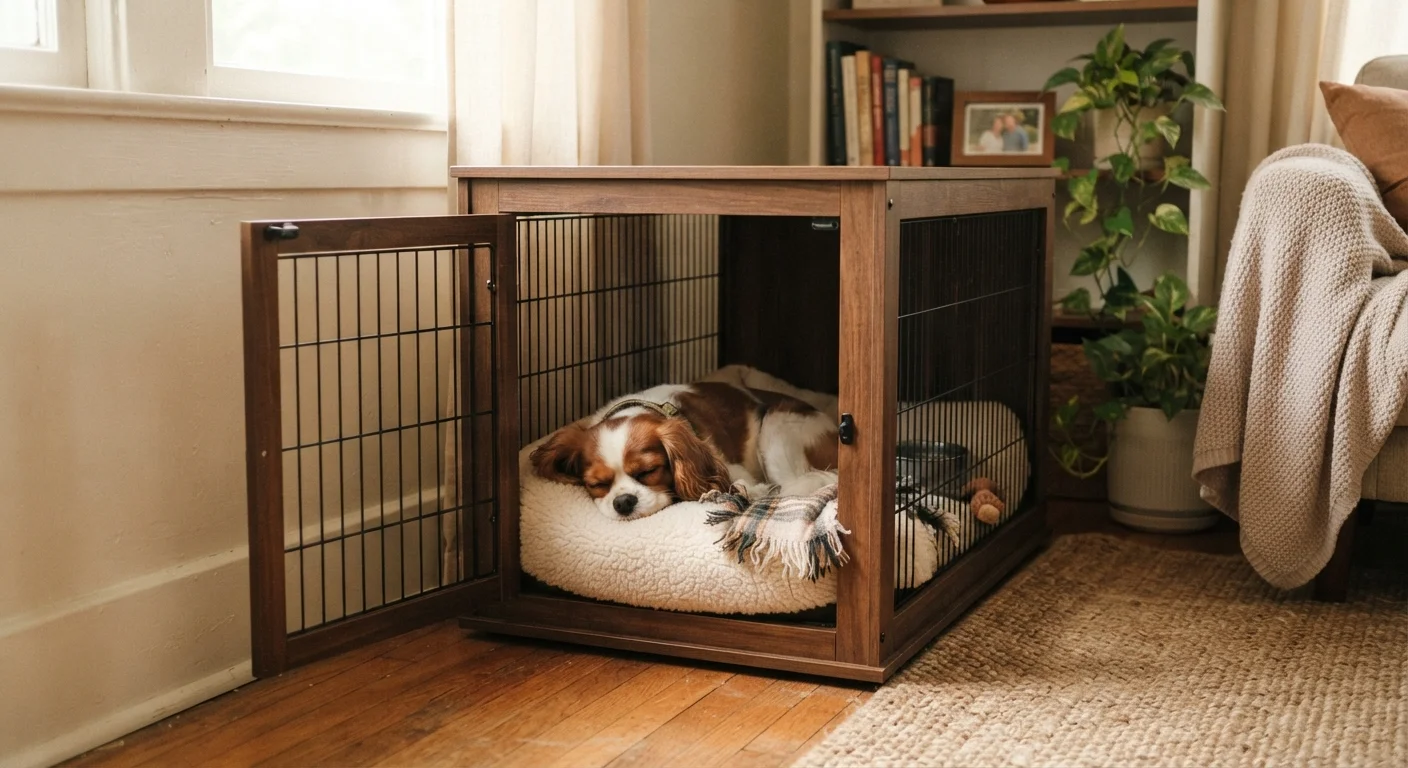
Photo: ResultsExplorer.com | Top Blogs For Everyone editorial
Key Takeaways
- Crate training works best when the crate is introduced gradually and associated with positive experiences.
- Forcing a dog into a crate or moving too fast creates anxiety that can be difficult to reverse.
- The right crate size — large enough to stand, turn, and lie down — is essential for comfort and success.
- Most dogs need days to weeks of incremental exposure before they are comfortable with the door closed.
- Never use the crate as punishment; its value depends entirely on your dog viewing it as a safe space.
Why Crate Training Matters
A crate, when introduced properly, taps into a dog's natural inclination to seek out a small, sheltered resting place. Far from being a cage, a well-used crate becomes the canine equivalent of a personal bedroom — a predictable retreat from household activity. This is especially valuable during the settling-in period. If you're welcoming a dog home for the first time, a crate gives your new pet one constant, controllable space while everything else is unfamiliar.
Beyond comfort, crate training supports housetraining, keeps puppies safe when unsupervised, and reduces destructive behavior driven by anxiety or boredom. It also gives dogs a clearly defined space during vet stays or travel, reducing stress in environments that would otherwise feel chaotic.
The approach that works — and that modern veterinary and behavioral organizations endorse — is positive, low-pressure, and paced entirely by the dog. Positive reinforcement methods are not just kinder; the behavioral science shows they produce more durable, generalizable learning than aversive techniques.
What you will need
Setting Up for Success: Choosing and Placing the Crate
Before introducing your dog to the crate, get the setup right. Size matters: the crate should allow your dog to stand without stooping, turn in a full circle, and lie stretched out. Too large, however, and a puppy may treat one corner as a toilet — a setback for housetraining. If you're buying a crate sized for an adult dog, use a divider panel to reduce the space temporarily.
Wire, plastic, and fabric crates each have trade-offs. Wire crates offer ventilation and visibility; plastic crates feel more den-like and travel well; fabric crates are lightweight but not suitable for dogs who chew or scratch. Choose based on your dog's temperament and intended use.
Placement shapes how quickly a dog accepts the crate. Position it in a room where the family spends time — a living room or bedroom — so the dog doesn't feel isolated. Avoid drafts, direct heat sources, and high-traffic corridors. A crate in a quiet corner of a busy room strikes the right balance: social without being overwhelming.
Inside, add a soft, washable bed or mat, and consider a worn item of your clothing for scent comfort. Cover three sides with a blanket or purpose-made crate cover to create a den atmosphere, leaving the front open.
Make the Crate Discoverable, Not Forced
Step-by-Step: Introducing the Crate
Crate training is not a single event but a sequence of small, successful experiences. Each step below should feel easy and pleasant for your dog before you move forward. Rushing any phase can create negative associations that take significant time to undo.
Introduce the crate with the door open
Place the crate in the room with the door open and let your dog investigate at its own pace. Drop high-value treats near the entrance, then just inside, gradually placing them further back. Do not push, lure aggressively, or shut the door during this phase. Some dogs walk in confidently within minutes; others need a day or two of casual investigation. Both are normal.
Begin feeding meals inside the crate
Once your dog enters the crate willingly, start placing its food bowl just inside the threshold. Over several sessions, move the bowl progressively further back until meals are eaten at the rear of the crate. Keep the door open throughout. The goal is your dog moving in and out freely, eating calmly, and showing no hesitation.
Close the door briefly during meals
Once your dog eats its full meal inside without tension, gently close the door while it eats. Open the door as soon as the meal is finished — do not latch it yet if your dog shows any concern. Gradually increase the time the door stays closed after eating, adding 30-second increments across sessions. Your dog should remain relaxed throughout.
Practice short departures from the room
With your dog comfortably resting in the latched crate, give a calm verbal cue — something consistent like "crate" or "bed" — and step out of sight for a minute or two. Return before any distress begins. Build duration gradually: 2 minutes, then 5, then 10, then 30. Vary your return intervals so your dog can't predict exactly when you'll be back, which helps reduce exit-anticipation anxiety.
Extend crating to longer absences and overnight
Once your dog can rest quietly in the crate for 30 minutes with you out of the room, longer absences become feasible. For overnight crating, position the crate in or near your bedroom initially — your presence and your scent reduce nighttime distress significantly. Puppies will likely need at least one overnight toilet break; set an alarm rather than waiting for them to cry.
Common Mistakes and How to Avoid Them
Even well-intentioned owners run into predictable pitfalls. The most common is crating for too long, too soon. Dogs — especially puppies — cannot hold their bladder for extended periods, and exceeding their limit inside a crate creates exactly the kind of negative experience that sets training back. A general guideline is one hour per month of age for puppies (up to a practical maximum), though individual variation is real and should guide your approach more than any formula.
Using the crate as a punishment is another significant misstep. The moment a dog associates the crate with being in trouble, its value as a safe space collapses. Keep your tone and body language neutral or positive every time you direct your dog toward the crate.
Responding to whining by immediately opening the door teaches a dog that vocalizing gets results. Instead, wait for a brief pause in whining before releasing — even a few seconds of quiet counts. If whining is intense and prolonged, the most likely cause is that you've moved through the steps too quickly.
Finally, maintenance matters. Even after a dog is reliably crate trained, continuing to offer the crate as an open, rewarding space — with occasional treats tossed in — keeps the positive association alive. Dogs that are crated only when the owner leaves can start to associate crate time with departures and develop anxiety around it.
The content provided on our blog site traverses numerous categories, offering readers valuable and practical information. Readers can use the editorial team’s research and data to gain more insights into their topics of interest. However, they are requested not to treat the articles as conclusive. The website team cannot be held responsible for differences in data or inaccuracies found across other platforms. Please also note that the site might also miss out on various schemes and offers available that the readers may find more beneficial than the ones we cover.