
How the Cooling System Stops Your Engine from Overheating

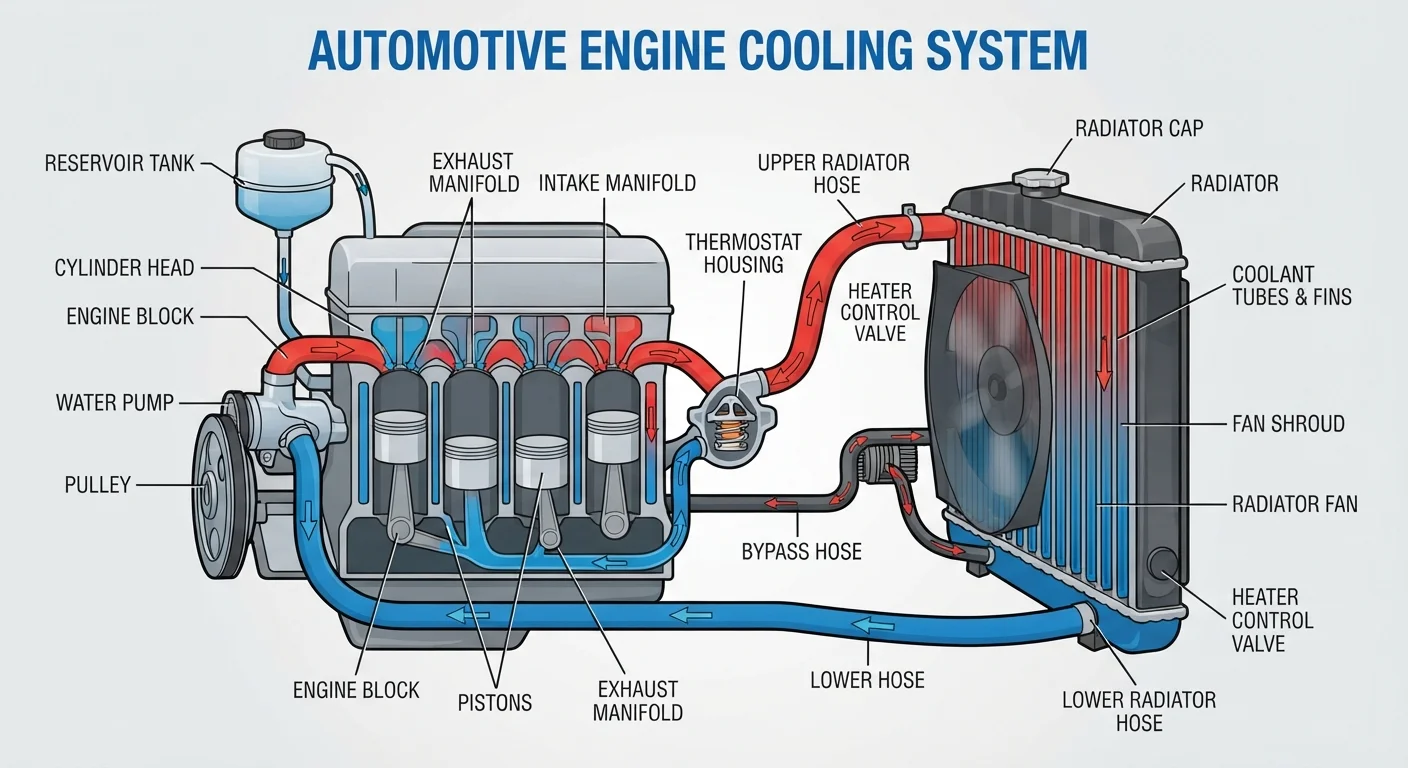
Photo: ResultsExplorer.com | Top Blogs For Everyone editorial
Key Takeaways
- The cooling system uses liquid coolant to absorb engine heat and carry it to the radiator for release.
- Four main components - the water pump, thermostat, radiator, and coolant - must all work together.
- Low or degraded coolant is one of the most common causes of engine overheating.
- The temperature gauge on your dashboard is an early warning system - never ignore a rising needle.
- Coolant should be inspected regularly and flushed on a schedule recommended in your owner's manual.
The Four Core Components
Understanding your cooling system starts with knowing the four parts that do the heavy lifting.
- Coolant: A mixture of antifreeze and water that absorbs heat from the engine block and cylinder head. It flows through a series of internal channels called a water jacket built directly into the engine.
- Water pump: A mechanically driven pump - typically belt-driven - that keeps coolant moving through the system. Without circulation, coolant sitting in the engine would overheat rapidly.
- Thermostat: A temperature-sensitive valve that stays closed when the engine is cold, allowing it to reach operating temperature quickly, then opens once the target temperature is reached, sending hot coolant to the radiator.
- Radiator: A flat, finned heat exchanger mounted at the front of the vehicle. Hot coolant flows through its narrow tubes while air - either from driving speed or a cooling fan - passes over the fins, carrying heat away.
These four components work as a continuous loop. When one fails, the others cannot compensate for long.
Coolant Color Varies by Formula
How Heat Is Managed While You Drive
When you start a cold engine, the thermostat stays closed, routing coolant in a small loop that bypasses the radiator. This allows the engine to warm up to its efficient operating temperature faster, which improves fuel combustion and reduces wear.
Once the coolant reaches roughly 195°F, the thermostat opens. The water pump pushes warm coolant out of the engine and into the upper radiator hose, through the radiator, and back again through the lower hose. By the time coolant completes the loop, it has shed a significant portion of its heat and is ready to absorb more.
A radiator cap plays a supporting role: it seals and pressurizes the system, raising the boiling point of the coolant from 212°F (the boiling point of plain water at sea level) to around 250°F or higher. This gives the system a much wider margin before coolant can boil and cause an airlock.
Never Open a Hot Radiator Cap
Signs the Cooling System Needs Attention
Your car gives clear signals when something is wrong. Recognizing them early can prevent costly engine damage.
- Rising temperature gauge: The most direct indicator. If the needle climbs toward the red zone, the system is struggling to control heat.
- Low coolant warning light: Many modern vehicles have a dedicated low-coolant sensor. Take this seriously - low coolant means reduced heat transfer capacity.
- Sweet or unusual smell: Coolant has a distinctly sweet odor. If you smell it inside or outside the car, a leak may be present.
- Puddles under the car: A bright green, orange, or pink liquid pooling under the engine bay is a strong sign of a coolant leak.
- White exhaust smoke: Persistent white smoke from the exhaust can indicate coolant entering the combustion chamber - often caused by a failed head gasket, a serious repair.
If any of these symptoms appear, have the vehicle inspected by a qualified mechanic promptly. Do not continue driving an overheating engine.
You can also learn to check coolant level yourself - see our guide to reading essential fluid levels for step-by-step instructions on finding and interpreting the coolant reservoir markings.
Keeping the System in Good Condition
The cooling system is relatively low-maintenance but does require periodic attention. Coolant degrades over time - its corrosion inhibitors break down, allowing rust and scale to build up inside the radiator and engine passages. Old coolant can also become acidic, accelerating damage to rubber hoses and metal components.
A coolant flush - draining the old mixture, flushing the system with clean water, and refilling with fresh coolant - removes that buildup and restores protection. Consult your owner's manual for the interval recommended for your specific vehicle; many fall in the 30,000-50,000 mile range, though some modern formulations are rated longer.
Between flushes, visually inspect the coolant reservoir when the engine is cool. The level should sit between the minimum and maximum marks. Also look at the condition of the coolant: it should be bright and clear in color, not brown or murky. Inspect hoses for cracks, softness, or swelling - these are signs that rubber is breaking down.
The cooling system works in close coordination with other vehicle systems. Understanding it alongside the braking system overview builds a well-rounded picture of what keeps your vehicle operating safely.
Frequently Asked Questions
The content provided on our blog site traverses numerous categories, offering readers valuable and practical information. Readers can use the editorial team’s research and data to gain more insights into their topics of interest. However, they are requested not to treat the articles as conclusive. The website team cannot be held responsible for differences in data or inaccuracies found across other platforms. Please also note that the site might also miss out on various schemes and offers available that the readers may find more beneficial than the ones we cover.