
Roundabout Navigation for Drivers Raised on Four-Way Stops

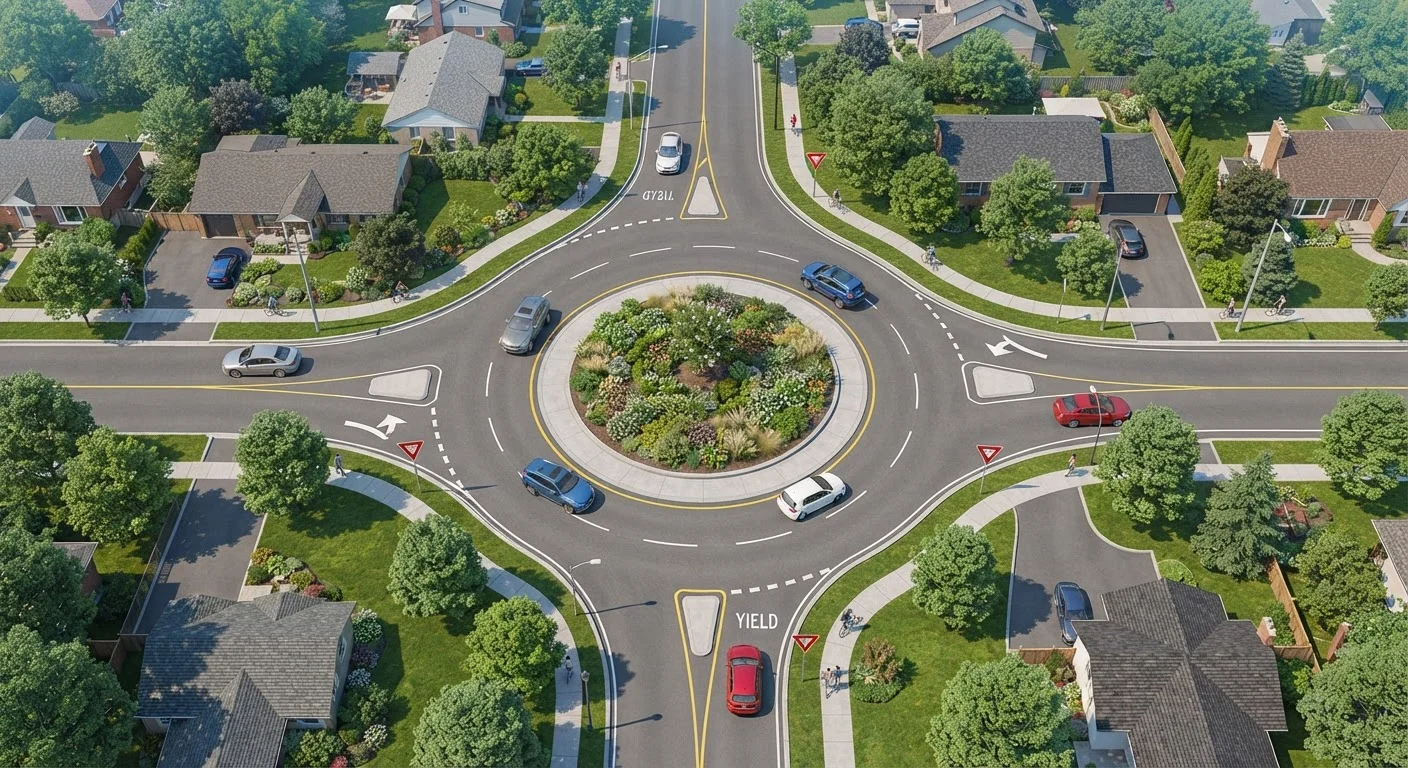
Photo: ResultsExplorer.com | Top Blogs For Everyone editorial
Key Takeaways
- Entering drivers must always yield to traffic already circulating inside the roundabout.
- You never stop inside a roundabout unless traffic ahead is stopped - keep moving at a consistent low speed.
- Lane choice at a multi-lane roundabout should be made before you reach the entry point.
- Roundabouts statistically reduce fatal and injury crashes compared with traditional signalized intersections.
- Pedestrians cross at marked crosswalks just outside the roundabout, not within the traffic circle itself.
What Makes a Roundabout Different
A roundabout is a circular intersection where all traffic flows counterclockwise around a raised center island. Unlike a four-way stop - where drivers take turns in a fixed sequence - a roundabout keeps vehicles moving continuously at low speeds, eliminating the full stop-and-go cycle that causes congestion and many collision types.
The key design difference is that yield replaces stop as the governing rule at entry. This single shift in logic trips up drivers who learned to look for a red light or a stop sign before moving. At a roundabout, your job at the entry point is to judge whether a gap in circulating traffic is large enough to enter safely - not to wait for a signal to grant you permission.
Roundabout
A circular intersection where all vehicles travel counterclockwise around a center island, with entering drivers yielding to those already inside.
Yield line
A dashed line at a roundabout entry marking where drivers must give way to circulating traffic before proceeding.
Splitter island
A raised or painted median that separates approaching and exiting traffic lanes and provides a refuge point for pedestrians crossing one lane at a time.
Truck apron
A slightly elevated paved ring around the center island that large vehicles can drive over when they need a wider turning radius to navigate the roundabout.
Circulating traffic
Vehicles already moving inside the roundabout; these drivers always have the right of way over vehicles waiting to enter.
Understanding this distinction is the foundation of everything else. Roundabouts are not chaotic; they are governed by clear, consistent rules that become instinctive with practice.
The Core Rules: Yield, Enter, Exit
Three actions define every roundabout pass-through:
- Yield at the entry. When you reach the dashed yield line at the entrance, check for vehicles already inside the circle. If the roundabout is clear, enter without stopping. If vehicles are circulating, wait for a safe gap.
- Travel counterclockwise. Once inside, stay in your lane and travel counterclockwise around the center island. Do not reverse, cut across the island, or change lanes abruptly.
- Signal and exit. Activate your right turn signal as you approach your exit - typically one exit before the one you intend to take. Yield to pedestrians in the crosswalk at the exit, then leave the roundabout.
Speed inside a roundabout is intentionally low - most are designed for 15-25 mph. That low speed is precisely what limits crash severity. Maintaining a consistent, moderate pace is safer than braking suddenly or accelerating to beat another driver.
For a broader look at how traffic signals and right-of-way interact, see our guide to traffic signals beyond red, yellow, and green.
Look Left First at the Entry Point
Choosing the Right Lane
Single-lane roundabouts are straightforward - there is only one path. Multi-lane roundabouts require a lane decision before you reach the entry, because changing lanes inside is dangerous and usually prohibited.
| Destination | Recommended lane |
|---|---|
| First or second exit (right turn or straight) | Right lane |
| Third exit or beyond (left turn or U-turn) | Left lane |
Signage and pavement markings at the approach will show which lanes lead to which exits. Look for these markings as you slow down - not at the last second. Approach signs often display a small diagram of the roundabout with arrows pointing to destinations.
If you miss your exit, do not back up or cut across lanes. Simply continue around the roundabout and take your exit on the next pass. It adds a few seconds and is far safer than forcing a last-moment maneuver.
Special Situations: Pedestrians, Trucks, and Emergency Vehicles
Pedestrians and cyclists cross at marked crosswalks located just outside the roundabout's yield line, not within the traffic circle itself. Before entering or exiting, yield to anyone in these crosswalks. Pedestrians generally cross one lane of traffic at a time, aided by the splitter island (the raised median between approach lanes).
Large vehicles - trucks, buses, and vehicles towing trailers - sometimes need extra room. Many modern roundabouts include a truck apron: a slightly elevated paved ring around the center island designed for large vehicles to mount when they need a wider turning radius. Passenger vehicles should not drive on the truck apron; it is reserved for oversize vehicles that physically require it.
Emergency vehicles present a specific challenge. If you hear sirens while approaching a roundabout, do not enter - pull to the right and wait. If you are already inside when an emergency vehicle appears, complete your exit promptly rather than stopping in the circle, then pull to the right once clear. Stopping mid-roundabout creates a secondary hazard. This principle connects to the broader framework of yielding for emergency vehicles covered in Move Over Laws: What Every US Driver Needs to Know.
Common Mistakes and How to Avoid Them
Even experienced drivers make predictable errors at roundabouts. Knowing them in advance makes them easier to avoid:
- Stopping unnecessarily at the entry. If the circle is clear, enter smoothly. Stopping when no vehicles are present causes rear-end risks - the same dynamic explored in our article on why tailgating is more dangerous than most drivers assume.
- Failing to yield when entering. The most common cause of roundabout crashes. Always check for circulating traffic first.
- Neglecting to signal. Signaling your exit helps drivers behind you and pedestrians anticipate your movement.
- Lane-changing inside the circle. Commit to your lane before entry. Weaving inside creates blind-spot conflicts.
- Driving too fast. Higher speeds undermine the roundabout's safety design. Follow posted advisory speed signs.
Roundabouts can feel unfamiliar at first, but the rules are simpler than a complex signalized intersection once you internalize the single governing principle: yield to what's already there, then move.
Never Stop Inside the Roundabout
Frequently Asked Questions
The content provided on our blog site traverses numerous categories, offering readers valuable and practical information. Readers can use the editorial team’s research and data to gain more insights into their topics of interest. However, they are requested not to treat the articles as conclusive. The website team cannot be held responsible for differences in data or inaccuracies found across other platforms. Please also note that the site might also miss out on various schemes and offers available that the readers may find more beneficial than the ones we cover.