
University Degree or Vocational Training: Understanding the Real Differences

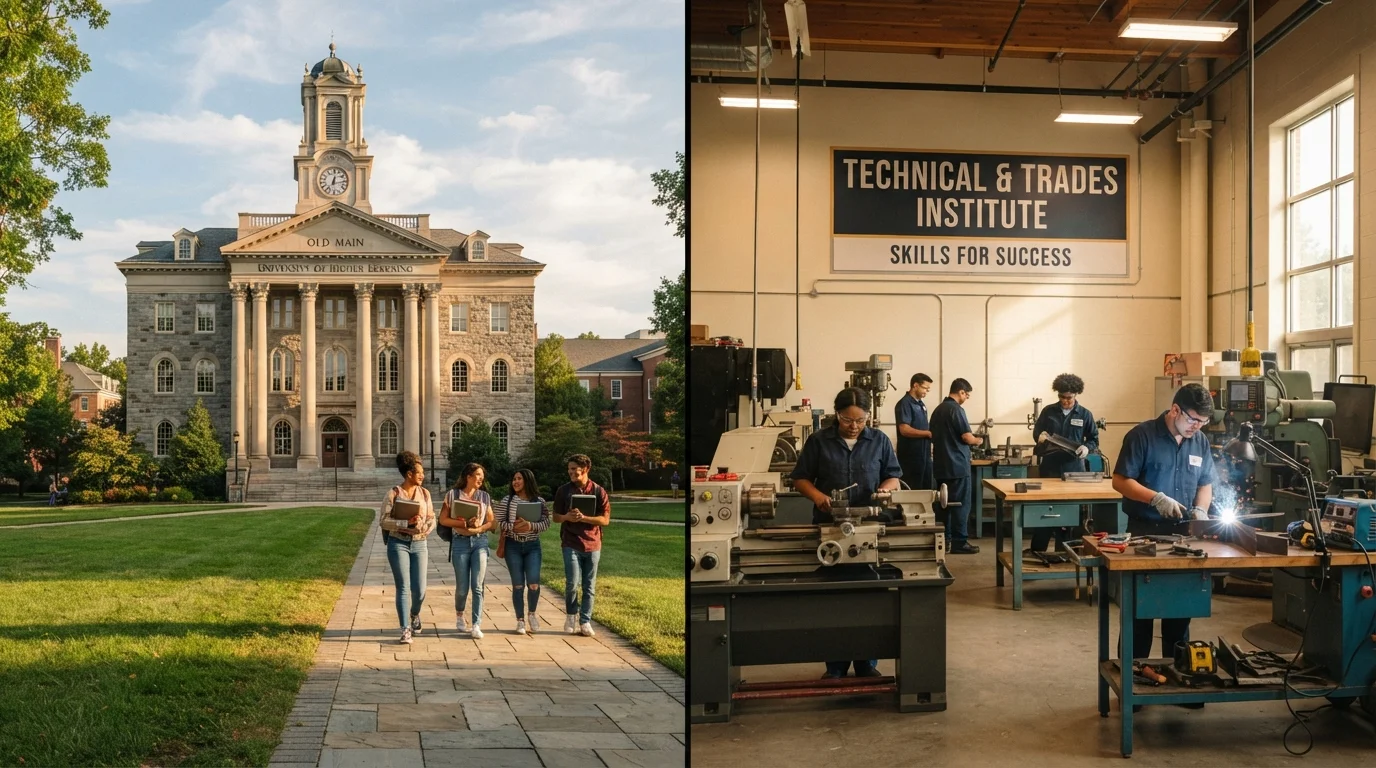
Photo: ResultsExplorer.com | Top Blogs For Everyone editorial
Key Takeaways
- University degrees typically take two to four years and develop broad academic and transferable skills alongside a major subject.
- Vocational training programs usually run six months to two years and build direct, occupation-specific competencies.
- Cost, time commitment, and employer expectations differ significantly between the two pathways.
- Neither route is universally superior - the better fit depends on the target career and the learner's personal circumstances.
- Both credentials can lead to strong earnings; vocational graduates in skilled trades often out-earn some four-year degree holders.
- Switching between pathways later is possible but can be costly - mapping your goals first saves time and money.
How Each Pathway Is Structured
A university degree - typically an associate's (two years) or bachelor's (four years) - is organized around a broad curriculum. Students complete general education requirements alongside courses in a declared major. The emphasis is on developing analytical thinking, written communication, and theoretical frameworks that transfer across industries. Coursework is assessed through essays, exams, projects, and research papers.
Vocational training - sometimes called career and technical education (CTE) or a trade program - is built around a specific occupation. Programs run anywhere from a few months to two years, depending on the credential (a certificate, diploma, or associate of applied science). Instruction is heavily lab-based or hands-on: students practice the actual tasks they will perform on the job. Many programs include a required externship, apprenticeship, or clinical placement before graduation.
Understanding exactly what each credential signals to employers starts with the terminology. See our guide to degrees, diplomas, and certificates for a clear breakdown of what each document actually represents.
| Criterion | University Degree | Vocational Training |
|---|---|---|
| Typical duration | 2-4 years | 6 months-2 years |
| Curriculum focus | Broad academic + major | Occupation-specific skills |
| Learning format | Lectures, essays, exams | Labs, practicum, apprenticeship |
| Typical cost (US) | Higher; varies by institution | Lower; community college or trade school |
| Credential awarded | Associate's or Bachelor's degree | Certificate, diploma, or AAS |
| Graduate school eligibility | Yes, typically required | Usually no; varies by program |
| Career flexibility | Broad lateral mobility | Deep in-field expertise |
| Time to employment | Longer | Shorter |
Cost, Time, and Return on Investment
The financial picture differs substantially. According to the National Center for Education Statistics (NCES), average annual tuition and fees at public four-year universities have risen steadily over the past two decades, while community college and vocational program costs remain considerably lower. A two-year vocational certificate may cost a fraction of a bachelor's degree, with proportionally less time spent out of the workforce.
That said, return on investment is not automatic for either path. High-demand skilled trades - electrical work, plumbing, medical imaging, cybersecurity technician roles - can command salaries that equal or exceed those of many four-year graduates. The U.S. Bureau of Labor Statistics Occupational Outlook Handbook provides median wage data by occupation that can help learners compare realistic earning trajectories before committing to a program.
~$11,260
Average annual public 4-year in-state tuition (2023-24)
According to the College Board's Trends in College Pricing report, this figure excludes room, board, and fees, which significantly increase total cost.
$61,070
Median annual wage for electricians (US, 2023)
Sourced from the U.S. Bureau of Labor Statistics Occupational Outlook Handbook; electricians typically complete a vocational program plus apprenticeship.
65%
Vocational completers employed in related field within 1 year
National Center for Education Statistics data indicates strong occupational alignment for graduates of accredited career and technical education programs.
Time is also a resource. Full-time university enrollment during a four-year degree means four years before first professional-level employment in most fields. A 12-month welding certificate or an 18-month dental hygiene program gets learners into the workforce - and earning - much sooner. For a deeper look at how enrollment schedule affects both cost and life balance, see our article on part-time versus full-time study.
Employer Recognition and Career Trajectories
Employer attitudes vary sharply by industry. In fields like nursing, accounting, civil engineering, or secondary education, a degree is a formal prerequisite - not a preference. In the skilled trades, construction, automotive technology, or culinary arts, a vocational credential combined with demonstrable skill and relevant licensure is precisely what employers expect. Applying a degree credential to a trade role does not automatically create an advantage.
Career trajectory is another dimension worth examining. University degrees generally offer broader lateral mobility - the ability to move across departments, industries, or roles over a career. Vocational credentials provide depth and fast entry but can require additional education if a worker later wants to move into management, engineering, or a related professional field. This is not a limitation unique to vocational paths; it is simply a structural characteristic worth planning around.
If you are making this decision as part of a career change rather than an initial career choice, the dynamics shift further. Our article on common mistakes career-changers make when choosing education explores the specific traps that derail adult learners who choose the wrong format for their situation.
It is also worth noting that neither of these two paths exhausts the full landscape of modern learning. Bootcamps, MOOCs, and short courses occupy a distinct space that may complement - or in some cases substitute for - traditional credentials. See our overview of non-traditional study formats for context on where those fit. For a comprehensive map of all pathways together, the complete guide to modern educational choices is a useful starting point.
The content provided on our blog site traverses numerous categories, offering readers valuable and practical information. Readers can use the editorial team’s research and data to gain more insights into their topics of interest. However, they are requested not to treat the articles as conclusive. The website team cannot be held responsible for differences in data or inaccuracies found across other platforms. Please also note that the site might also miss out on various schemes and offers available that the readers may find more beneficial than the ones we cover.