
Massed Practice vs. Spaced Practice: Choosing the Right Schedule for What You're Learning

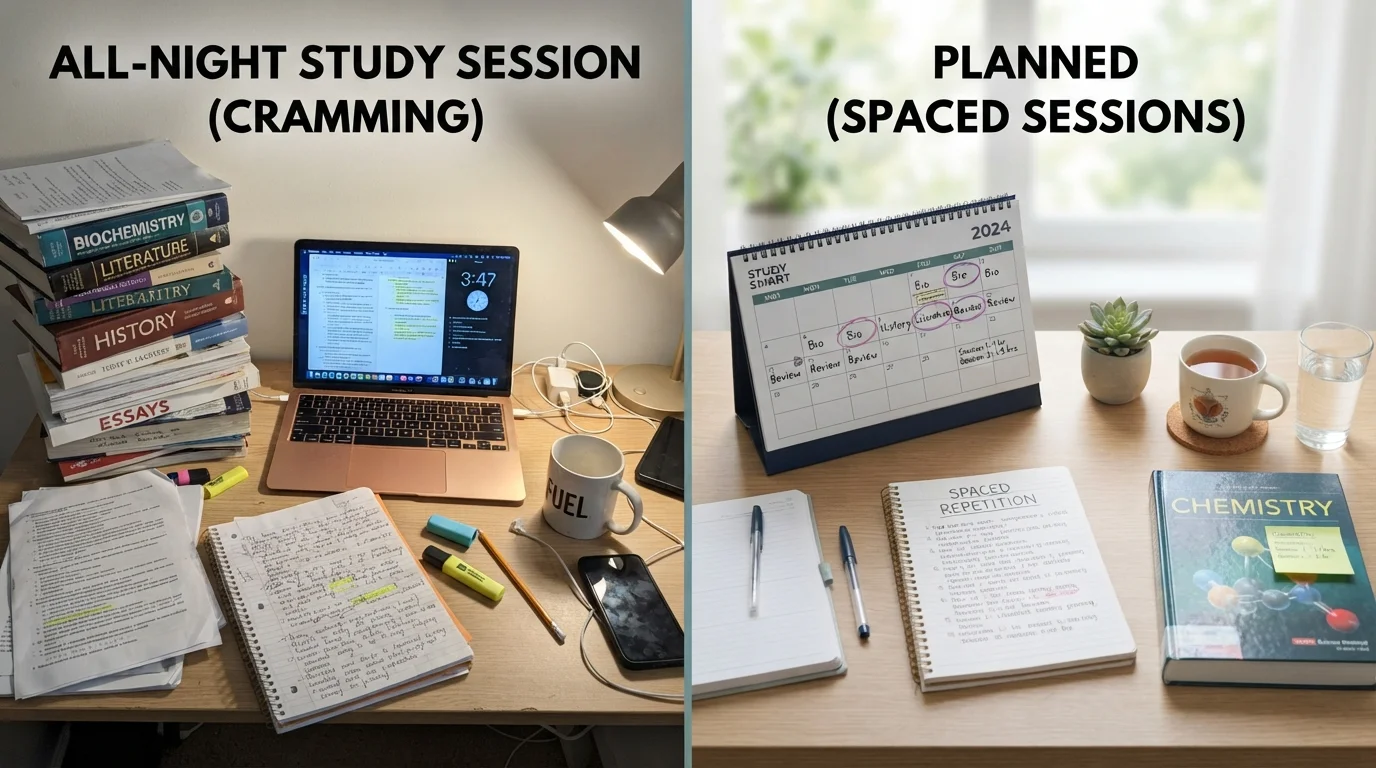
Photo: ResultsExplorer.com | Top Blogs For Everyone editorial
Key Takeaways
- Massed practice concentrates all study into one block; spaced practice spreads sessions across time.
- Decades of memory research consistently show spaced practice produces stronger long-term retention.
- Massed practice can be useful for warming up a motor skill or preparing for an imminent performance.
- The right choice depends on your goal: immediate execution versus durable, transferable learning.
- Combining both approaches strategically — massed for initial exposure, spaced for consolidation — often yields the best results.
What Each Approach Actually Means
Massed practice means studying or drilling a skill in one continuous, uninterrupted block — think rehearsing a presentation for three hours straight the night before, or working through 50 math problems in a single sitting. Coaches sometimes call this "cramming." It feels productive because you're clocking large amounts of time in one go.
Spaced practice — also called distributed practice — means breaking that same total study time into sessions separated by gaps. Instead of three hours on Sunday, you might spend 45 minutes on Monday, Wednesday, and Friday, plus a short review the following week. The content and effort are similar; the schedule is completely different.
That scheduling difference turns out to matter enormously. The spacing effect — the finding that distributed practice produces stronger long-term memory than equivalent massed practice — is one of the most replicated results in cognitive psychology. For a deeper look at why the brain responds this way, see why spreading out study sessions leads to stronger retention.
| Criterion | Massed Practice | Spaced Practice |
|---|---|---|
| Session structure | One continuous block | Multiple sessions with gaps |
| Long-term retention | Weaker; fades quickly | Stronger; durable over time |
| Short-term performance | Can be effective immediately | Builds toward sustained performance |
| Cognitive load | Higher per session | Distributed; easier to manage |
| Best skill type | Motor warm-up, one-off tasks | Conceptual, language, professional skills |
| Requires planning | Low — just block time | Moderate — schedule intervals ahead |
| Evidence strength | Mixed, context-dependent | Robust across many decades of research |
When Massed Practice Actually Helps
It would be wrong to dismiss massed practice entirely. Research in motor learning — the science of how we acquire physical skills — shows that concentrated blocks of repetition can be effective for priming a movement pattern shortly before you need to perform it. A musician running through a piece several times the morning of a recital, or a surgeon refreshing a laparoscopic technique before a procedure, is using massed practice appropriately.
Massed practice also works well for initial exposure to entirely new material. Spending a focused afternoon getting a first pass through unfamiliar concepts gives your brain the raw material it needs. The mistake is stopping there and assuming that first-pass familiarity equals durable learning.
One more legitimate use: when the skill is genuinely disposable — a one-off presentation you'll never give again, or trivia for a single event — the cost of forgetting is low, and a concentrated session may be perfectly efficient. Be honest with yourself about whether that's actually your situation.
~200%
Retention advantage of spaced over massed practice
A widely cited meta-analysis by Cepeda and colleagues (2006) in Psychological Bulletin found spaced practice produced roughly twice the retention of massed practice across hundreds of studies.
1–2 days
Optimal gap for early spaced reviews
Research on the spacing effect suggests that for material studied in a single session, a review within 24–48 hours substantially slows the rate of forgetting before a longer interval is introduced.
5–40%
Typical exam score improvement with spaced study
Educational psychology reviews estimate students who replace massed review with spaced retrieval practice improve test performance by roughly 5–40 percentage points depending on the domain and baseline.
Why Spaced Practice Dominates for Long-Term Learning
The mechanism behind spacing is well understood. Every time you retrieve information after a meaningful gap, the act of effortful recall strengthens the underlying memory trace. Psychologists call this the retrieval practice effect — the harder the retrieval feels, the more durable the learning becomes. This is also why re-reading the same page right after you just read it produces minimal benefit: the material is still in working memory, so no real retrieval is required.
Spacing also aligns with how memory consolidation works during sleep. When you study, then sleep, then return to the material, your brain has had time to integrate new knowledge with existing knowledge — a process called consolidation. Massed practice before a single sleep session compresses this window significantly.
For anyone building knowledge that must transfer across contexts — a language, a professional skill, academic content — spaced practice is the evidence-supported default. This connects directly to managing how much new information you take on at once; see how cognitive load affects skill acquisition for the underlying science.
Building a Practical Schedule That Uses Both
The most effective learners don't treat this as a binary choice. A sensible pattern is to use a brief massed session for initial exposure — getting the lay of the land — and then immediately convert to a spaced schedule for consolidation and deeper encoding.
A simple three-phase approach works well for most learners:
- Initial block (massed): Spend 60–90 minutes on first contact with new material. Take notes; identify what confuses you.
- First spaced review: Return within 24–48 hours for a shorter, active session — practice retrieval rather than re-reading. For guidance on that technique, see active recall vs. re-reading.
- Expanding intervals: Schedule subsequent reviews at progressively longer gaps — roughly one week, then two to four weeks — adjusting based on how easily you can retrieve the material.
Pair this with interleaved practice — mixing topics within spaced sessions — and you further strengthen discrimination between concepts, which is especially valuable when preparing for exams or professional evaluations.
Finally, note that practice method matters alongside practice schedule. Doing the same drill repeatedly without pushing past your comfort zone has limits. See deliberate practice vs. repetition for how to make each session count.
The content provided on our blog site traverses numerous categories, offering readers valuable and practical information. Readers can use the editorial team’s research and data to gain more insights into their topics of interest. However, they are requested not to treat the articles as conclusive. The website team cannot be held responsible for differences in data or inaccuracies found across other platforms. Please also note that the site might also miss out on various schemes and offers available that the readers may find more beneficial than the ones we cover.