
The Real Cost of Minimum Payments on a Credit Card Balance

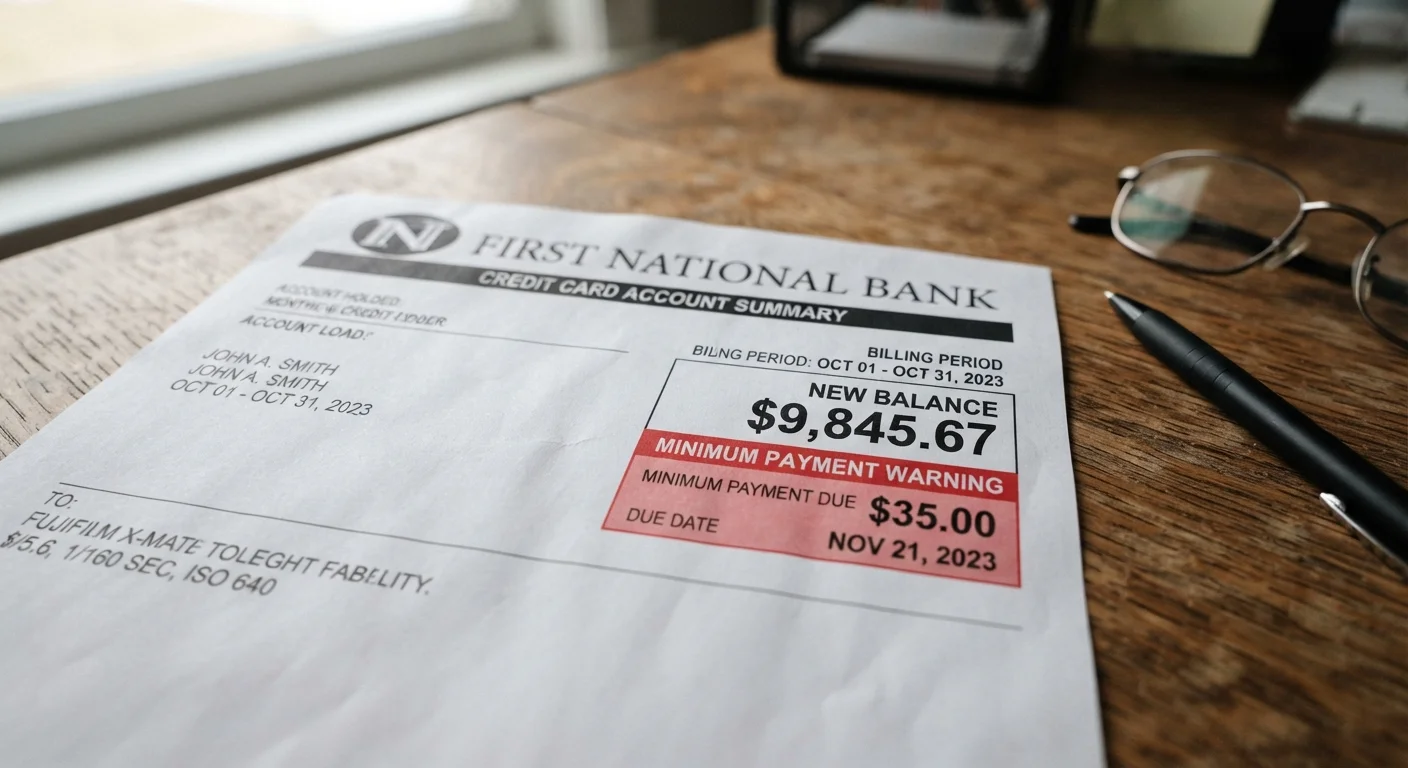
Photo: ResultsExplorer.com | Top Blogs For Everyone editorial
Key Takeaways
- Minimum payments protect you from late fees but do not meaningfully reduce your principal balance.
- High interest rates cause most of a minimum payment to cover interest charges, not the underlying debt.
- A $3,000 balance at 22% APR can take over a decade to pay off with minimum-only payments.
- Even modestly larger payments can cut years off your repayment timeline and save hundreds in interest.
- Credit card statements are now required by law to show how long minimum-only repayment will take.
- There is no single right repayment amount — but paying more than the minimum almost always helps.
Why Minimum Payments Feel Safe But Often Aren't
Paying the minimum each month checks the box. You avoid a late fee, your account stays current, and your issuer reports the payment as on time. On the surface, it looks like responsible behavior. The problem is what's happening beneath the surface — specifically, how interest compounds on the balance you're not paying down.
When you carry a balance from month to month, your issuer applies your annual percentage rate (APR) to that remaining amount. With average credit card APRs consistently above 20% in recent years, a significant portion of every minimum payment goes straight to covering interest charges. Very little reduces the principal — the actual debt you owe.
This dynamic is not accidental. Minimum payments are structured to keep accounts in good standing while maximizing the interest income issuers collect over time. Understanding this doesn't require any suspicion of bad faith — it's simply how the math works, and knowing it gives you a clearer picture of what you're agreeing to when you make only the required payment.
A Common Misconception About Minimum Payments
What the Numbers Actually Look Like
Consider a concrete illustration. Suppose you carry a $3,000 balance on a card with a 22% APR, and your issuer sets the minimum at 2% of the balance (or $25, whichever is greater). In the first month, your minimum payment would be roughly $60. Of that, approximately $55 covers the monthly interest charge — leaving only about $5 to reduce your principal.
As your balance slowly shrinks, so does the minimum payment — which means you're paying less each month, but the balance shrinks even more slowly. Under this structure, paying off that $3,000 could take well over a decade and cost more than $3,000 in interest alone — meaning you'd pay close to double the original debt.
20%+
Average credit card APR in recent years
Federal Reserve data has shown average credit card interest rates consistently exceeding 20% APR, making the cost of carrying a balance particularly high.
15+ years
Potential repayment period on minimum-only payments
A $3,000 balance at 22% APR, paid at a shrinking 2% monthly minimum, can take well over 15 years to fully eliminate under standard amortization models.
~$5
Principal reduced per minimum payment in early months
On a $3,000 balance at 22% APR with a 2% minimum, the first payment of roughly $60 may reduce principal by as little as $5 after interest is applied.
Now compare that to paying a fixed $150 per month on the same balance and APR. You'd be debt-free in roughly 24 months and pay a fraction of the interest. The payment is larger, but the total cost is far lower. That gap is what the minimum payment structure costs you over time.
What Your Statement Is Required to Tell You
Since the Credit CARD Act of 2009 took effect, issuers are legally required to include a minimum payment warning on every monthly statement. This disclosure shows two key numbers: how long it will take to pay off your current balance making only minimum payments, and the total interest you'll pay over that period. It also shows the fixed monthly amount needed to clear the balance in 36 months.
Many cardholders overlook this box or don't fully process what the numbers mean. But it's one of the most useful pieces of financial data on your statement — and it's placed there precisely because the gap between minimum-payment outcomes and accelerated-payment outcomes is so significant.
If you're uncertain about what your current statement shows, it's worth locating that disclosure before your next payment. The numbers may be more motivating than any financial article can be. For a broader look at how credit card habits interact with your overall credit profile, the Debt & Credit resource hub covers repayment strategies alongside credit fundamentals.
How to Pay More — Even When Money Is Tight
There's no single right answer for how much above the minimum you should pay. It depends on your income, other obligations, and the interest rates on any other debts you carry. What matters most is the direction: paying even $20 or $30 more than the minimum each month meaningfully changes the long-term cost of carrying a balance.
One practical starting point is to look at your statement's 36-month payoff figure and treat that as a target, rather than the minimum. If that amount isn't feasible right now, split the difference. Any additional payment above the minimum reduces principal faster and triggers less compounding interest going forward.
It's also worth noting that minimum-only payment behavior can interact with your credit utilization ratio — the percentage of your available credit that you're using — which is a meaningful factor in how your credit score is calculated. Balances that barely move month to month keep utilization elevated. Habits that quietly erode a good credit score explores this and similar patterns in more depth.
If your income is genuinely stretched, resources on managing debt when money is tight can help you prioritize which balances to focus on first — even when you can't attack all of them at once.
This article is for general informational and educational purposes only and does not constitute personalized financial or legal advice. Consult a qualified financial professional for guidance specific to your situation.
Frequently Asked Questions
The content provided on our blog site traverses numerous categories, offering readers valuable and practical information. Readers can use the editorial team’s research and data to gain more insights into their topics of interest. However, they are requested not to treat the articles as conclusive. The website team cannot be held responsible for differences in data or inaccuracies found across other platforms. Please also note that the site might also miss out on various schemes and offers available that the readers may find more beneficial than the ones we cover.