
Raw Food vs. Kibble: Understanding the Real Differences

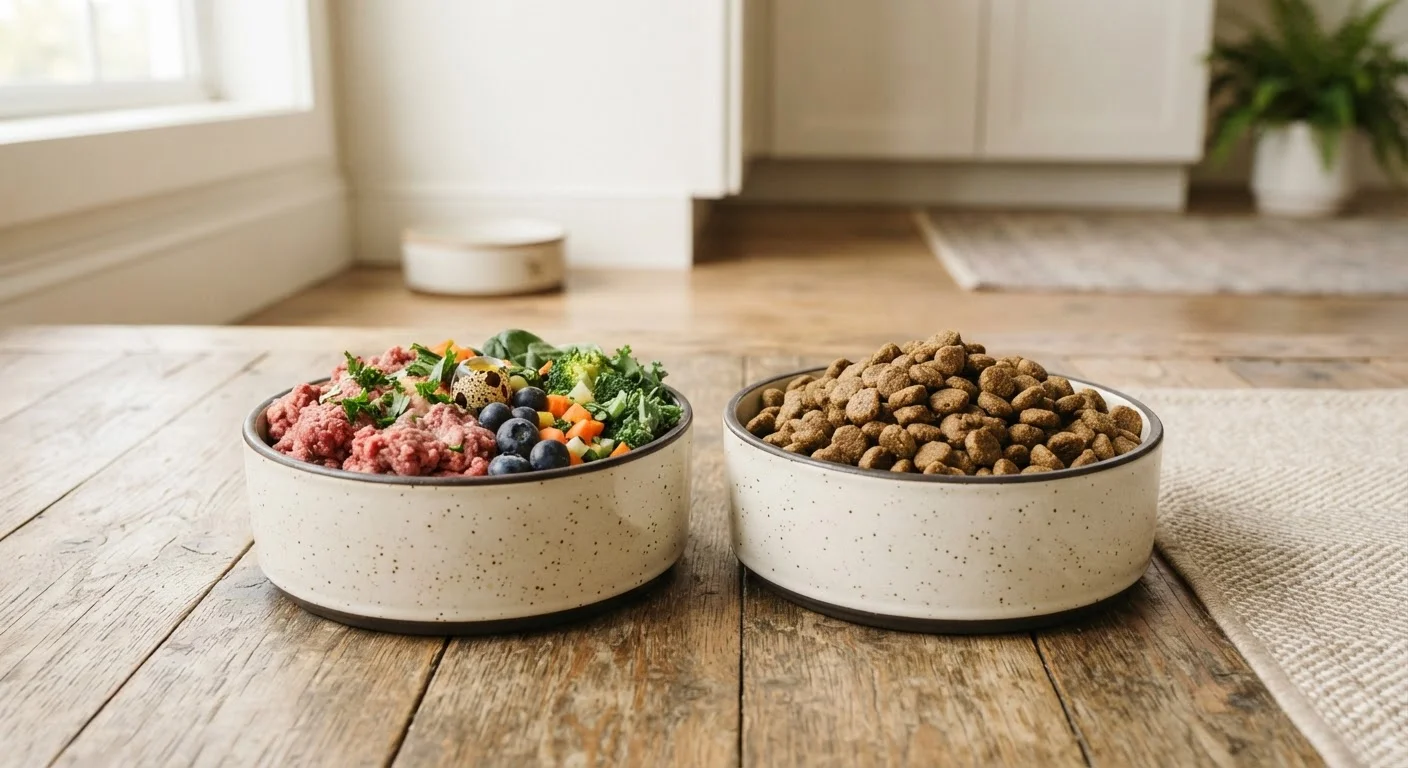
Photo: ResultsExplorer.com | Top Blogs For Everyone editorial
Key Takeaways
- Raw diets can offer fresh whole ingredients but carry documented pathogen risks for dogs and humans alike.
- Kibble is nutritionally formulated to meet AAFCO standards, making balanced feeding more predictable.
- Neither diet is universally superior — the right choice depends on your dog's health, life stage, and your household situation.
- Homemade raw diets are frequently found to be nutritionally incomplete without professional formulation.
- Always consult a veterinary nutritionist before switching diets, especially for puppies, seniors, or immunocompromised dogs.
What Each Diet Actually Is
A raw food diet — sometimes called BARF (Biologically Appropriate Raw Food) or a prey-model diet — typically consists of uncooked muscle meat, organ meat, raw meaty bones, and sometimes fruits or vegetables. These diets may be home-prepared or purchased commercially as frozen or freeze-dried products. The core idea is that less processing preserves more of the food's original nutritional structure.
Kibble, by contrast, is a dry extruded or baked product made from a blend of protein meals, carbohydrates, fats, vitamins, and minerals. The ingredients are cooked under high heat and pressure, which extends shelf life, destroys most pathogens, and allows manufacturers to calibrate nutrients to meet established dietary standards. Most commercial kibbles in the US are formulated to meet guidelines set by the Association of American Feed Control Officials (AAFCO).
Understanding what each diet involves day-to-day is essential before weighing the research. For more context on reading what goes into any commercial product, see our guide on decoding dog food labels.
Nutrition: What the Evidence Shows
Kibble's main nutritional advantage is consistency. Because formulations are designed against a defined standard, a dog fed a complete-and-balanced kibble is unlikely to develop nutrient deficiencies when fed as directed. Long-term feeding studies on commercial dry foods are also far more extensive than those on raw diets.
Raw diets present a more complicated nutritional picture. Studies published in peer-reviewed journals, including research cited by the British Veterinary Association and the American Veterinary Medical Association (AVMA), have found that a significant proportion of home-prepared raw diets are nutritionally incomplete — lacking adequate calcium, phosphorus, or key vitamins. Commercial raw products are more likely to be balanced, but regulation is less uniform than for kibble.
~60%
Home-prepared raw diets found nutritionally incomplete
Multiple peer-reviewed analyses of home-formulated raw diets have found that the majority fail to meet established canine nutritional requirements without professional formulation.
High
Contamination rate in raw pet food FDA surveys
FDA sampling programs have consistently detected Salmonella and Listeria monocytogenes in a notable proportion of commercially available raw pet food products tested.
2x+
Higher reported cost vs. equivalent kibble
Consumer and veterinary nutrition surveys generally find commercial raw diets cost substantially more per daily feeding than mid-range dry kibble of comparable protein content.
Proponents of raw feeding often point to higher moisture content, less processed protein, and the absence of artificial additives as potential benefits. These claims are plausible in principle, but large-scale controlled trials demonstrating measurable health advantages in dogs — such as improved coat condition, digestion, or longevity — remain limited. For context on how animal protein quality is evaluated more broadly, our overview of animal vs. plant protein sources is a useful reference.
Safety and Handling Considerations
Food safety is where the raw vs. kibble debate becomes most consequential. The AVMA, the US Food and Drug Administration (FDA), and the Centers for Disease Control and Prevention (CDC) have all issued guidance noting that raw meat-based diets can be contaminated with pathogens including Salmonella, Listeria monocytogenes, and E. coli. These organisms can infect dogs and can spread to humans through contact with the food, feeding bowls, or the dog's feces and saliva.
This risk is not theoretical. The FDA has conducted multiple surveys finding high rates of bacterial contamination in commercially available raw pet food products. The concern is especially serious in households with infants, older adults, pregnant individuals, or anyone with a compromised immune system.
Vulnerable Households: A Key Consideration
Kibble, by contrast, poses a much lower pathogen risk. High-heat processing destroys most harmful bacteria. Standard kitchen hygiene when scooping and storing kibble is generally sufficient for healthy households.
For raw feeders who proceed after consulting their vet, safe handling includes dedicated preparation surfaces, thorough handwashing, freezing practices that reduce (but do not eliminate) pathogens, and keeping raw food away from human food preparation areas.
Day-to-Day Practicalities and Trade-Offs
Kibble wins on convenience by a wide margin. It is shelf-stable, straightforward to portion, easy to travel with, and widely available. Cost per meal is generally lower than commercial raw products, though premium kibbles can close that gap considerably.
Raw feeding demands more from owners: freezer space, careful thawing protocols, more frequent shopping, and precise portioning — particularly for homemade diets, which ideally should be formulated by a board-certified veterinary nutritionist to avoid deficiencies. Commercial raw products simplify this but add cost.
| Criterion | Raw Food Diet | Kibble |
|---|---|---|
| Nutritional standardisation | Variable; depends on formulation | AAFCO-regulated; consistent |
| Pathogen risk | Significant; documented contamination | Low; heat processing destroys most bacteria |
| Preparation time | High; thawing, portioning, cleaning | Minimal; scoop and serve |
| Storage requirements | Freezer space required | Dry pantry or cupboard |
| Cost (typical) | Higher, especially commercial raw | Wide range; generally lower |
| Ingredient transparency | High for home-prepared | Moderate; label reading required |
| Suitability for therapeutic diets | Limited validated options | Wide prescription range available |
Dogs with specific health conditions — kidney disease, pancreatitis, food allergies, or gastrointestinal disorders — often benefit from prescription or therapeutic diets, for which kibble formats are far more clinically established and readily accessible than raw equivalents.
Whichever diet you choose, life stage matters. Puppies, pregnant dogs, and seniors have distinct nutritional needs that require diets specifically validated for those groups. A conversation with your veterinarian before switching or starting any diet is not optional — it is the foundation of responsible feeding. For a similarly balanced look at another consequential dog health decision, see our overview on neutering a dog.
This article provides general educational information about dog nutrition and is not a substitute for personalised advice from a licensed veterinarian or board-certified veterinary nutritionist.
The content provided on our blog site traverses numerous categories, offering readers valuable and practical information. Readers can use the editorial team’s research and data to gain more insights into their topics of interest. However, they are requested not to treat the articles as conclusive. The website team cannot be held responsible for differences in data or inaccuracies found across other platforms. Please also note that the site might also miss out on various schemes and offers available that the readers may find more beneficial than the ones we cover.