
Why Closing a Credit Card Can Hurt Your Score

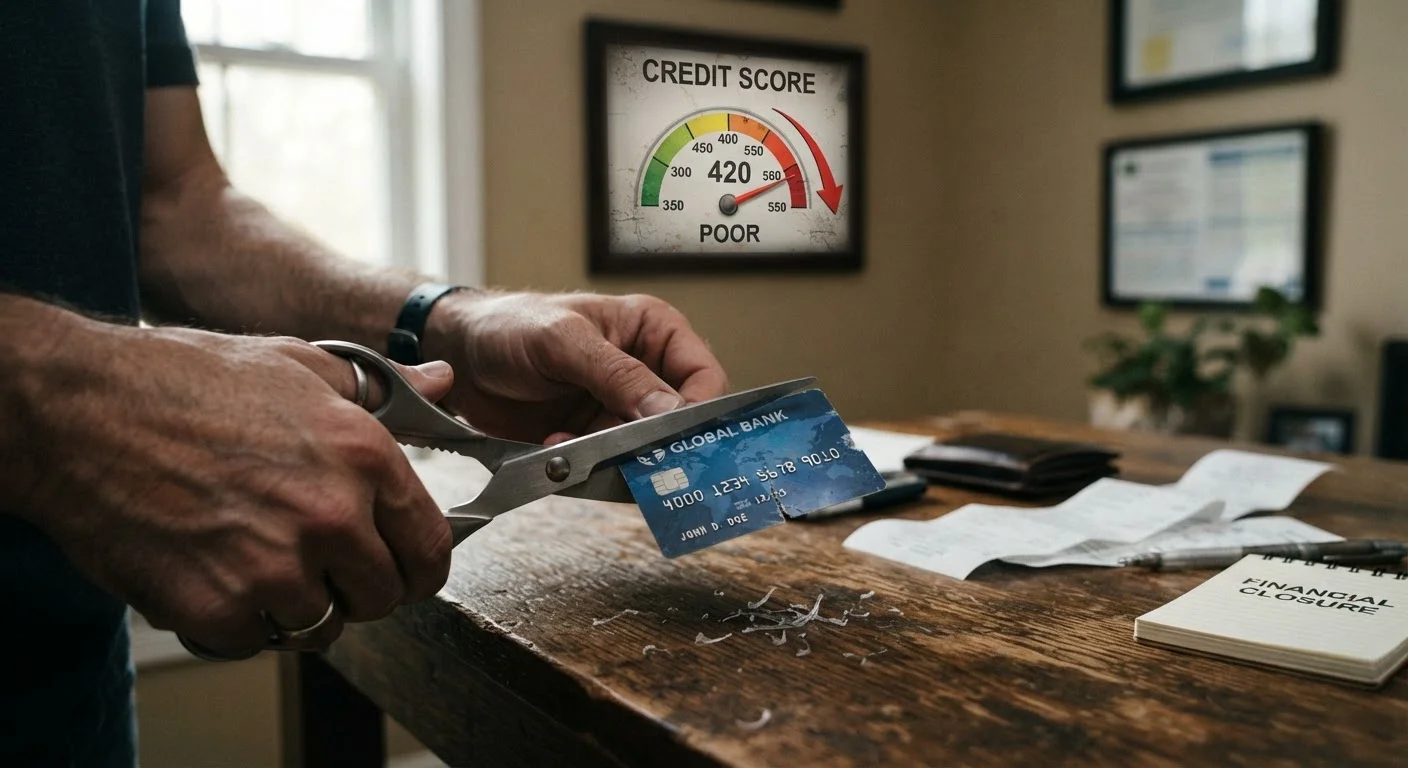
Photo: ResultsExplorer.com | Top Blogs For Everyone editorial
Key Takeaways
- Closing a credit card reduces your total available credit, which raises your credit utilization ratio.
- A higher utilization ratio can lower your credit score, even if your spending hasn't changed.
- Closing an older card shortens your average account age, which also affects your score.
- The impact is usually temporary, but it can matter most when you're planning to apply for a loan.
- Keeping low-use cards open with zero or minimal balances is often the better strategy.
- Consulting a financial professional can help you decide the right move for your specific situation.
The Two Scoring Factors Most Affected
To understand why closing a card can hurt your score, it helps to know what a credit score actually measures. Two factors take a direct hit when you cancel an account. For a fuller picture of how scores are built, see Credit Scores Decoded.
Credit Utilization
Your credit utilization ratio is the percentage of your total available credit that you're currently using. If you have three cards with a combined limit of $15,000 and carry $3,000 in balances, your utilization is 20%. Close one card with a $5,000 limit and suddenly your available credit drops to $10,000 — pushing that same $3,000 balance to 30% utilization. Scoring models generally reward staying below 30%, and ideally below 10%.
Average Age of Accounts
Lenders like to see a long, stable credit history. Scoring formulas consider both the age of your oldest account and the average age of all your accounts. Closing an older card removes it from that average calculation over time, which can make your credit profile look younger and less established than it really is.
Closed Accounts Don't Vanish Immediately
When the Impact Stings Most
Not every closure causes the same ripple. The effect is sharpest in a few specific situations:
- High-limit cards: The bigger the credit line you remove, the larger the jump in your utilization ratio.
- Your oldest card: Closing the account you've had the longest can meaningfully reduce your average account age.
- Before a major loan application: Applying for a mortgage or auto loan within months of a closure can mean lenders see a score that hasn't fully recovered.
- Thin credit profiles: If you only have two or three accounts, losing one has a proportionally bigger impact than it would on a profile with ten accounts.
Understanding these triggers is part of avoiding the habits that quietly erode a good credit score over time.
Smarter Alternatives to Closing
If you want to simplify your wallet or stop paying an annual fee, consider these options before you cancel outright:
- Downgrade the card: Many issuers let you switch to a no-fee version of the same card, preserving the account age and credit limit.
- Leave the card open with a small recurring charge: A single monthly subscription keeps the account active without encouraging overspending.
- Request a credit limit increase on other cards first: If you do plan to close a card, offsetting the lost limit elsewhere can soften the utilization impact.
It's also worth separating fact from fiction. Many people close cards based on misconceptions — for instance, the belief that carrying a small balance builds credit faster than paying in full. It doesn't. For a rundown of widespread misunderstandings, see credit score myths that lead to poor borrowing decisions.
Before You Cancel, Do This First
This article is for general informational purposes only and does not constitute personalized financial advice. For guidance tailored to your situation, consider speaking with a licensed financial professional.
Frequently Asked Questions
The content provided on our blog site traverses numerous categories, offering readers valuable and practical information. Readers can use the editorial team’s research and data to gain more insights into their topics of interest. However, they are requested not to treat the articles as conclusive. The website team cannot be held responsible for differences in data or inaccuracies found across other platforms. Please also note that the site might also miss out on various schemes and offers available that the readers may find more beneficial than the ones we cover.