
Feline Enrichment: Meeting Your Cat's Mental and Physical Needs Indoors

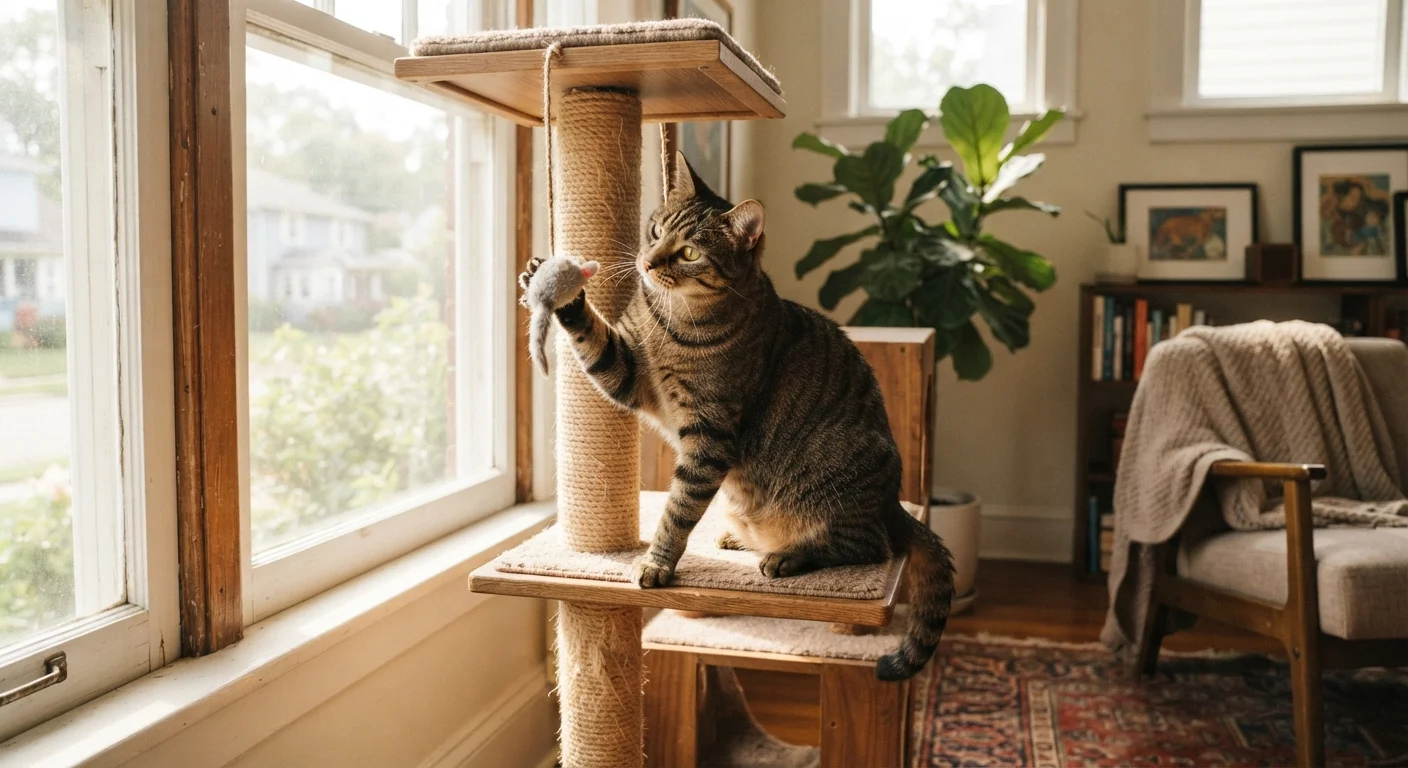
Photo: ResultsExplorer.com | Top Blogs For Everyone editorial
Key Takeaways
- Indoor cats lack natural stimulation and require deliberate environmental enrichment to stay healthy.
- Vertical space, hiding spots, and perches satisfy feline territorial and security instincts.
- Puzzle feeders and interactive play replace the mental effort cats would spend hunting prey.
- Scent-based enrichment taps into one of cats' most powerful sensory systems.
- Behavioural problems like overgrooming often signal unmet enrichment needs, not just personality quirks.
- Enrichment strategies should evolve as cats age to match changing physical and cognitive capacities.
Why Indoor Cats Need Deliberate Enrichment
Domestic cats remain closely wired to their wild ancestry. A free-roaming cat may patrol a territory spanning several acres, engage in multiple hunts daily, and encounter complex sensory input continuously. Confine that same animal indoors without structured stimulation, and the mismatch between instinct and environment becomes a genuine welfare concern.
The American Association of Feline Practitioners and other veterinary bodies recognise environmental enrichment as a core component of indoor cat care — not an optional luxury. Without it, cats commonly develop chronic stress, boredom-driven behaviours, and even physical health problems. Understanding what your cat actually needs starts with recognising what their biology drives them toward: hunting sequences, territorial exploration, social navigation, and sensory engagement.
Rotate toys every few days rather than leaving the same set available indefinitely. Cats habituate quickly to static items, so novelty is what sustains engagement.
Place at least one litter box in a low-traffic area where your cat can use it without feeling exposed or cornered. Security during elimination is a genuine welfare need, not a preference.
When introducing a puzzle feeder, start with the easiest difficulty level so your cat experiences early success. Frustration without reward extinguishes interest rapidly.
Vertical Space and Environmental Structure
Cats are vertical thinkers. Height confers safety awareness and social advantage in multi-cat households, which is why a cat will reliably choose the highest available perch. Cat trees, wall-mounted shelves, and window ledges aren't indulgences — they're functional territory.
A well-structured indoor environment includes:
- Elevated resting spots at multiple heights, allowing cats to survey the room
- Hiding spaces at ground level, such as enclosed beds or cardboard boxes, for retreat and security
- Scratching surfaces in both vertical and horizontal orientations, which fulfil postural stretching, claw conditioning, and scent-marking needs simultaneously
- Window access with a stable perch, offering visual stimulation from outdoor movement and light
In multi-cat homes, providing multiple elevated routes and resting spots reduces resource competition and social tension. The goal is a space where every cat can move, rest, and observe without feeling cornered.
Learn more about how scent marking connects to feline environmental comfort, including why scratching posts placed near entry points matter for territorial signalling.
Hunting, Foraging, and Play
The hunting sequence — stalk, pounce, catch, kill, eat — is neurologically satisfying for cats independent of hunger. Indoor cats denied this outlet often redirect the impulse into unwanted behaviours: ankle ambushing, compulsive play aggression, or excessive vocalisation.
Interactive wand toys that mimic prey movement are among the most effective enrichment tools available. Sessions of five to fifteen minutes, offered once or twice daily, allow cats to complete the hunting sequence and reach the calming post-hunt state. Crucially, always end sessions with a small food reward or meal — this completes the biological loop.
Puzzle feeders and food-dispensing toys extend this further by requiring cats to work for their meals. Research in applied animal behaviour consistently shows that food-motivated problem-solving reduces stress and boredom in captive felids. Even simple options — kibble scattered across a textured mat or hidden in paper rolls — introduce cognitive effort that a bowl of food cannot replicate.
Avoid Leaving Wand Toys Unsupervised
For guidance on how feeding format connects to overall feline health, see the differences between wet and dry cat food and what they mean for everyday feeding decisions.
Sensory and Cognitive Stimulation
A cat's sensory world is dominated by smell. Their olfactory system is roughly fourteen times more sensitive than a human's, and scent underpins nearly every aspect of feline social and environmental assessment. Enriching a cat's scent environment is one of the most underutilised strategies available to owners.
Safe options include rotating novel scents such as dried catnip, valerian root, or silver vine, as well as introducing items with outdoor smells (a pinecone, a handful of leaves) in a controlled way. Understanding how cats use scent to read their world explains why these inputs carry such outsized significance for feline wellbeing.
Cognitive enrichment can also include training. Cats are trainable using reward-based methods, and short daily sessions teaching simple behaviours — targeting, sit, entering a carrier voluntarily — provide mental challenge while strengthening the human-animal bond. Training sessions should be brief (two to three minutes) and always end on a successful, rewarded behaviour.
Social Enrichment and Human Interaction
Cats are often characterised as solitary, but this overstates the case. Domestic cats are capable of forming genuine social bonds with humans and other animals, and quality interaction contributes meaningfully to their welfare. The key word is quality: interactions driven by the cat's initiation and preference are far more enriching than forced handling.
Observe what your cat seeks. Some cats are content with proximity and parallel activity; others actively solicit play or petting. Responding to these cues consistently builds trust and reduces anxiety. For cats living alone for extended work hours, scheduled interactive sessions morning and evening are more beneficial than unpredictable bursts of attention.
A second cat can provide social enrichment, but compatibility is not guaranteed. Introductions require careful, gradual management. For some cats — particularly those with a history of solitary living — solo environments with excellent human engagement remain preferable to a poorly matched feline companion.
Recognising Signs of Understimulation
Behavioural problems in indoor cats frequently have an enrichment deficit at their root. Common presentations include:
- Overgrooming or barbering fur, sometimes to the point of hair loss
- Redirected aggression toward owners or other pets
- Repetitive behaviours such as pacing or wool-sucking
- House-soiling outside the litter box without a medical cause
- Excessive vocalisation, particularly at night
- Lethargy combined with weight gain
None of these signs should be dismissed as personality traits without first ruling out unmet behavioural needs. A veterinarian can help distinguish medical causes from environmentally driven ones. Consulting a certified feline behaviour consultant may also be warranted for persistent or escalating issues.
Adapting Enrichment Across Life Stages
Enrichment is not one-size-fits-all across a cat's lifespan. Kittens need high-energy play, exploration opportunities, and positive socialisation experiences during sensitive developmental windows. Adult cats benefit from variety and routine in roughly equal measure. Senior cats require a thoughtful recalibration.
As cats age, physical limitations may reduce their ability to jump, climb, or engage in extended play. Ramps or steps to formerly accessible perches, gentler interactive toys, and shorter but more frequent sessions maintain engagement without causing strain. Cognitive enrichment — scent work, food puzzles — remains valuable and accessible even as mobility declines.
For a deeper look at supporting older cats' changing needs, see evidence-informed approaches to senior feline care, and pair this with an understanding of how feline nutritional needs shift across life stages to support your cat's overall quality of life.
If you're also caring for other species at home, the enrichment principles for cats share interesting parallels with approaches used for birds — explore mental stimulation strategies for parrots to see where the needs diverge and where they align.
The content provided on our blog site traverses numerous categories, offering readers valuable and practical information. Readers can use the editorial team’s research and data to gain more insights into their topics of interest. However, they are requested not to treat the articles as conclusive. The website team cannot be held responsible for differences in data or inaccuracies found across other platforms. Please also note that the site might also miss out on various schemes and offers available that the readers may find more beneficial than the ones we cover.